The Attention Economy Has Changed
Consumers in 2026 have developed what marketers politely call “selective awareness.”
Translation?
People are brilliant at ignoring things.
Banner blindness is real.
Social media fatigue is real.
Even premium digital placements are fighting for milliseconds of attention.
But DOOH has evolved differently.
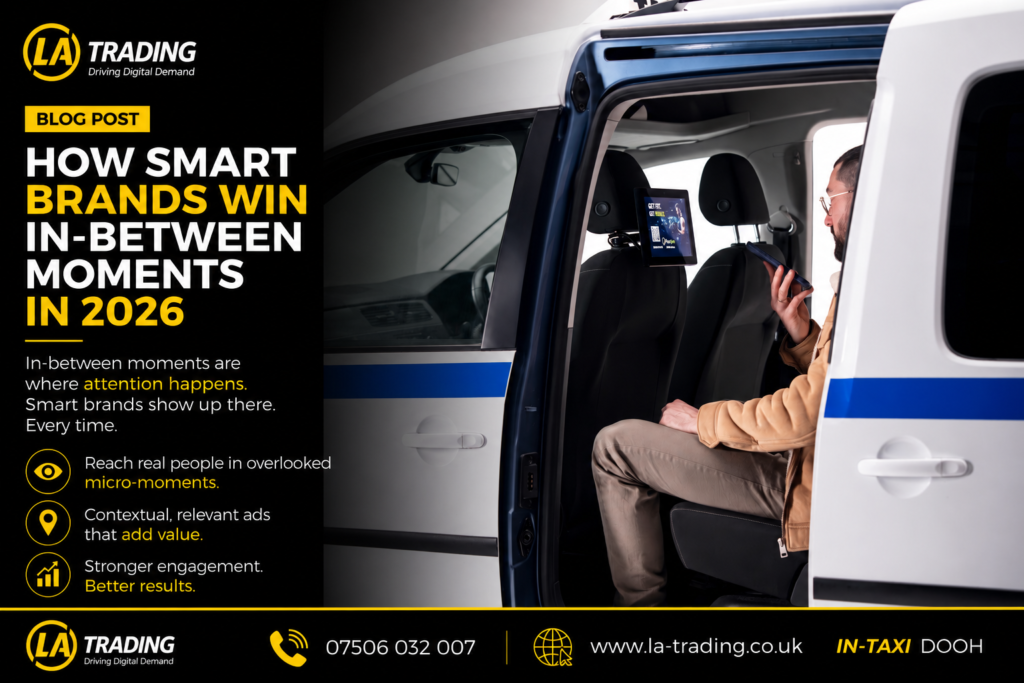
Instead of interrupting someone’s experience, smart DOOH formats are becoming part of the environment itself.
Inside taxis, audiences aren’t speed-scrolling.
They’re travelling. Waiting. Thinking. Looking around.
It’s one of the rare advertising environments left where people naturally engage without feeling overwhelmed.
And for brands, that’s gold dust.
Why Taxi DOOH Feels Different
Here’s what makes taxi-based DOOH quietly powerful:
1. It Reaches People During Real Life
Not during doom-scrolling.
Not while skipping YouTube ads.
Real life.
Commuting to work.
Heading to dinner.
Travelling to events.
Airport runs.
Business meetings.
Your brand becomes part of someone’s actual day — not just another disposable impression online.
2. The Environment Is Naturally Captive
Most advertising fights for divided attention.
Taxi DOOH doesn’t have to.
Passengers are seated directly in front of the screen for extended periods, often with fewer distractions than almost any other advertising environment.
That creates something most modern marketing struggles to buy:
Focused attention.
3. It Complements Traditional OOH Beautifully
The smartest campaigns in 2026 aren’t choosing between billboard advertising or DOOH.
They’re combining them.
Large-format OOH builds fame and broad awareness.
Taxi DOOH extends the journey into more personal, contextual moments.
It’s not replacement marketing.
It’s layered marketing.
And agencies are increasingly planning campaigns that move consumers from mass visibility into deeper engagement environments.
The Rise of “Journey-Based Advertising”
One of the biggest shifts happening right now inside OOH strategy is journey mapping.
Brands are no longer asking:
“How many people saw this ad?”
They’re asking:
“Where was the customer emotionally when they saw it?”
That changes everything.
A passenger travelling through Manchester on a Friday night experiences advertising differently to someone rushing through a train station at 7:30am.
Taxi DOOH taps into these transitional emotional moments incredibly well.
And because campaigns can update dynamically, messaging can adapt based on:
- Time of day
- Location
- Events
- Audience behaviour
- Weather
- Traffic flow
That flexibility is why digital OOH continues growing year after year.
The Brands That Will Win Attention in 2026
It won’t necessarily be the brands spending the most.
It’ll be the brands creating:
- memorable environments
- emotionally timed messaging
- contextual experiences
- campaigns that feel human
People remember how advertising feels.
That’s why some of the strongest-performing DOOH campaigns today don’t feel overly polished or corporate. They feel relevant. Timely. Smart.
Sometimes even funny.
Especially funny.
Because let’s be honest — if someone laughs in the back of a taxi because of your advert, you’ve already won more attention than most online ads ever achieve.
Final Thought: Visibility Is Easy. Attention Is Rare.
There’s no shortage of places to advertise in 2026.
But environments where people are genuinely present?
That’s becoming rare.
The future of OOH isn’t about replacing traditional formats. Far from it. The industry is evolving into something more connected, layered, and experience-driven than ever before.
And brands that understand the value of attention — not just impressions — are the ones audiences will actually remember.
So next time you plan a campaign, ask yourself:
Is your brand just being seen…
Or is it becoming part of the journey?
Because those in-between moments?
They’re no longer empty space.
They’re where modern brand decisions are being made