OOH creates the introduction
Traditional OOH remains one of the most powerful ways to make a brand feel established, visible and culturally present.
It puts businesses into real environments rather than hiding them behind an algorithm. It can influence commuters, shoppers, tourists and local communities without demanding that they first follow, subscribe or accept cookies.
That scale matters.
The challenge is not whether OOH creates awareness. The more useful question is:
What happens after the audience has noticed the brand?
A person may see a campaign while crossing a road, waiting for a bus or walking through a city centre. They recognise the name and absorb the message, but the environment may not give them enough time to investigate further.
That is where a complementary format can continue the conversation.
The customer journey should not end at awareness
Marketing plans often divide activity into two simplified categories:
- Brand awareness
- Direct response
Real people are not quite so tidy.
Most customers do not move from “never heard of you” to “take my money” within one advert. They notice, remember, reconsider, compare and eventually act.
The middle of that process is valuable because this is where familiarity begins turning into intention.
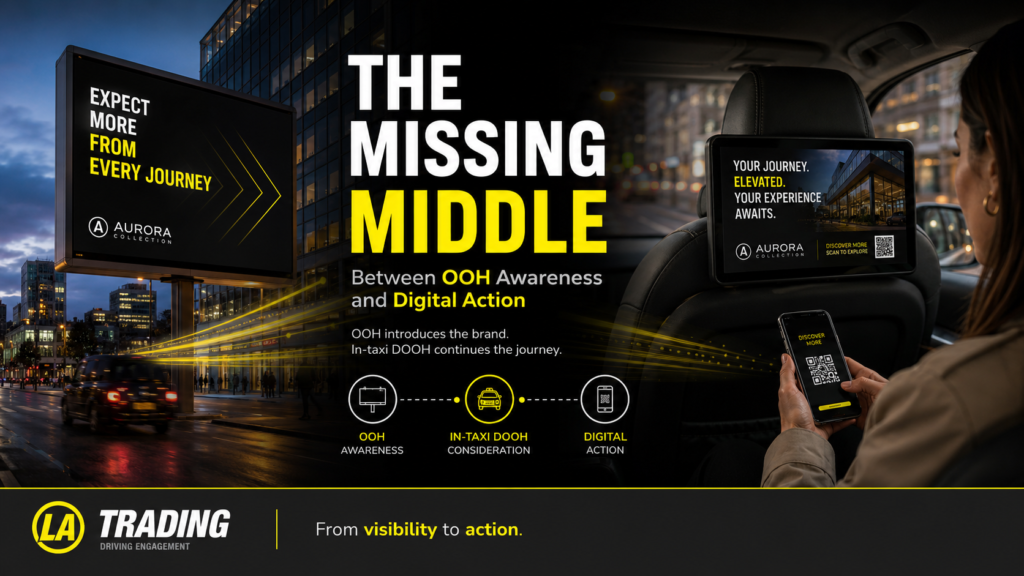
Journey-based DOOH can support that middle stage by giving audiences more time to absorb a campaign after the initial moment of public visibility.
Inside a taxi, a passenger has already chosen to pause. They are moving between locations, but they are not navigating the road themselves. That creates a different viewing mindset from someone rushing past an advert while checking whether the pedestrian light is still green.
The message can breathe.
The brand can explain more.
The customer can decide whether it is relevant.
Think of it as the second chapter, not a replacement
The smartest media strategies do not ask whether OOH or DOOH is “better”.
They ask what each environment is best placed to achieve.
A large roadside or city-centre placement can create scale, stature and recognition.
An internal digital taxi screen can then provide additional context, such as:
- A product benefit
- A local offer
- A launch date
- A short brand story
- Directions to a venue
- A QR code
- A reason to enquire
- A campaign-specific call to action
This is not about replacing the original OOH message. It is about giving the audience another opportunity to move closer.
Imagine seeing a hospitality brand promoted in a busy city location. Later, during the taxi journey to your hotel, you see the same brand presenting a nearby offer with a simple booking prompt.
The first placement created recognition.
The second made the recognition useful.
That is the missing middle working properly.
Why journeys matter in 2026
Modern audiences are surrounded by messages, but not every environment offers the same quality of attention.
The value of journey-based DOOH is not simply that a screen exists inside a vehicle. It is that the screen appears during a natural transition point.
Passengers may be:
- Travelling to a meeting
- Heading into a city centre
- Visiting a hotel
- Going to an event
- Returning from a shopping trip
- Exploring an unfamiliar area
- Deciding where to eat or what to do next
These are moments when people are already thinking about their destination, schedule and next decision.
A well-planned advert can become part of that thought process rather than another interruption.
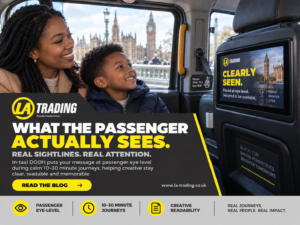
LA Trading’s in-taxi network is designed around this type of journey environment, where brands can appear during approximately 10–30 minutes of passenger travel and combine local relevance with digital creative.
Awareness becomes stronger when it feels connected
One isolated impression can be memorable.
A connected sequence is usually more persuasive.
When someone sees a brand across complementary environments, the campaign begins to feel consistent rather than repetitive. The audience does not necessarily think, “I have now received impression number three.”
They think:
“I keep seeing this brand.”
That small distinction matters.
Repeated recognition can create confidence, especially for businesses asking customers to try something unfamiliar, book an experience or make a higher-value purchase.
The aim is not to chase people around the city with the same advert.
It is to let each placement contribute something different.
For example:
- Large-format OOH: Introduce the campaign.
- In-taxi DOOH: Add relevance or information.
- Mobile or landing page: Make action easy.
- Physical location: Deliver the experience.
That is a joined-up customer journey rather than a collection of unrelated media bookings.
The creative should progress too
A connected strategy works best when the creative develops between environments.
The in-taxi advert should not automatically become a miniature copy of a large billboard. Trying to squeeze an entire outdoor design onto a smaller digital screen can leave every element fighting for attention like relatives at a family buffet.
Instead, ask what the passenger should understand next.
The answer may be:
- Why the product is different
- Where the business is located
- What offer is available
- When the event takes place
- What action the passenger should take
The second message should reward familiarity rather than restarting the introduction.
A simple planning question
Before approving the next campaign, ask:
Once someone notices our OOH advertising, what is the most helpful message they could receive next?
That question can transform in-taxi DOOH from an additional placement into a strategic continuation.
The answer will vary by brand.
For a property developer, it could be a virtual-tour prompt.
For a restaurant, it could be a nearby booking opportunity.
For an event, it could be dates, availability or directions.
For a national brand, it could be a product story that would not fit comfortably into the original headline.
Do not leave interested audiences halfway
OOH is exceptionally good at making brands visible in the real world. Digital formats can build on that strength by creating more responsive, contextual and measurable opportunities.
The future is not a choice between physical reach and digital interaction.
It is a better connection between the two.
Because introducing yourself brilliantly and then disappearing is not a funnel.
It is networking.
Ready to explore what should happen after your audience notices you? Speak to LA Trading about using in-taxi DOOH as the next stage of your OOH campaign, or download the media pack to see how your brand could continue the journey.