More plays is not the same as better creative
Frequency can build familiarity.
That is useful.
But repeating weak creative more often simply gives people more opportunities to ignore it.
The starting point should still be:
Is the idea worth seeing again?
Good repetition reinforces:
- the brand
- a distinctive visual
- an offer
- a useful message
- a memorable phrase
Bad repetition reinforces:
“Ah yes. That advert again.”
Not quite the brand lift study we were hoping for.
DOOH gives advertisers more options
Traditional OOH has always understood repetition.
People repeatedly travel along roads.
Use stations.
Visit town centres.
Commute.
Shop.
OOH becomes familiar because it exists within those routines.
Digital OOH adds the ability to change the message.
That changes the planning question from:
“How often?”
to:
“How often — and with what?”
That second part is increasingly important.
One campaign does not always need one advert
Imagine a hospitality campaign.
Creative one:
NEW RESTAURANT. NOW OPEN.
Creative two:
DINNER PLANS? SORTED.
Creative three:
SCAN FOR TONIGHT’S MENU.
Same campaign.
Same visual identity.
Different roles.
Now frequency helps build recognition without forcing exactly the same execution into every moment.
That is where digital inventory becomes genuinely useful.
The passenger environment makes rotation interesting
Inside a taxi, the passenger stays in the environment while the media rotates.
That creates different planning opportunities from a fleeting roadside encounter.
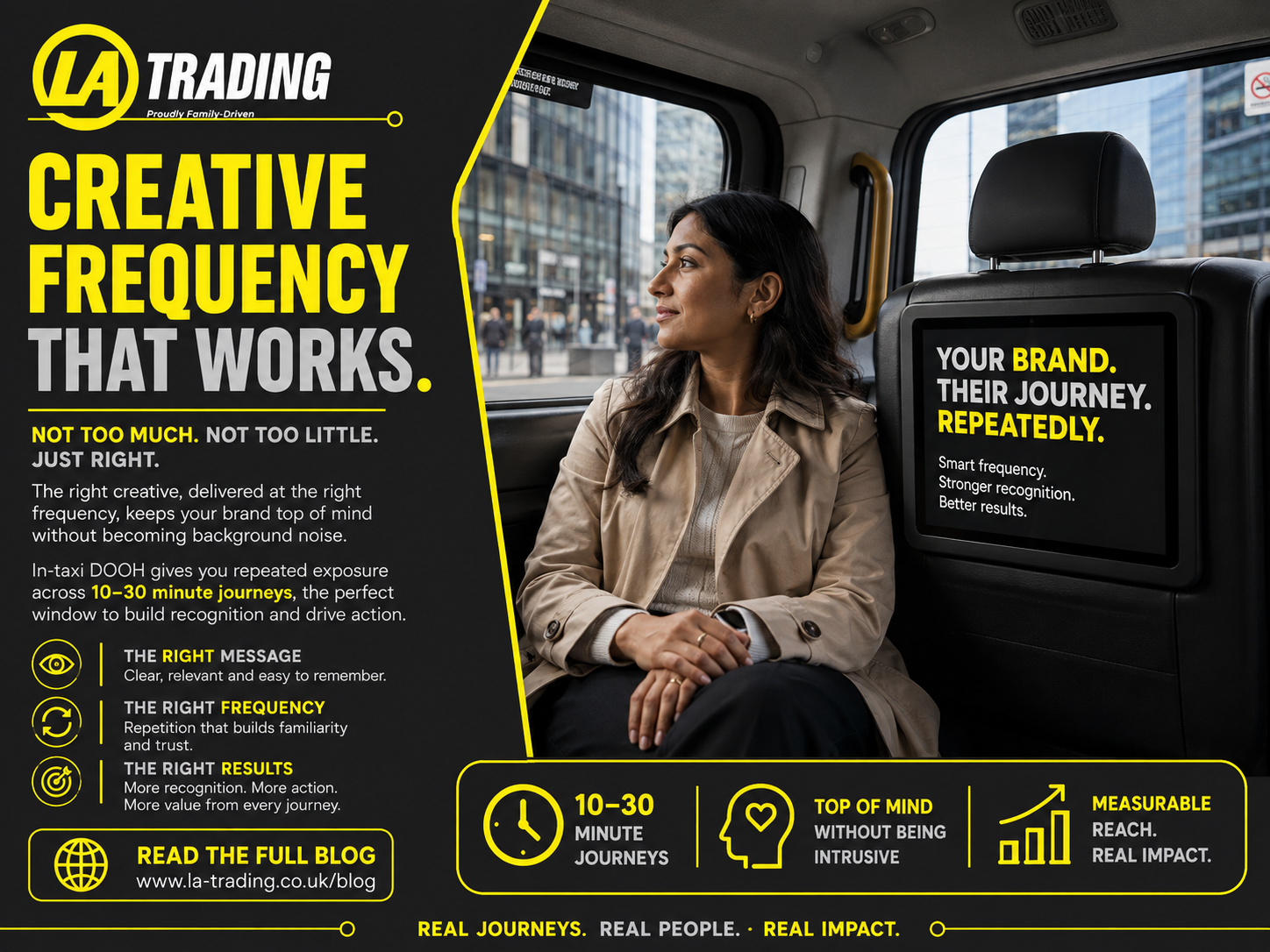
At LA Trading, advertisers can use internal digital screens during passenger journeys, creating the possibility of repeated brand presence across the ride.
The creative therefore needs to consider:
- campaign frequency
- advert duration
- rotation
- number of messages
- journey length
- CTA
- creative consistency
This is not simply:
“Can we squeeze another animation in?”
It is:
“What does the passenger need to understand after seeing us once, twice or again later in the journey?”
Ten seconds and fifteen seconds should have different creative jobs
A shorter execution can be excellent for:
recognition
simple offers
strong visual ideas
reminders
A longer execution may provide more room for:
a short story
a product demonstration
a little more explanation
a stronger build into a CTA
Neither automatically makes the campaign better.
Creative length should follow the message.
Not the other way around.
If the entire idea can be communicated brilliantly in six seconds, congratulations.
You do not receive bonus points for making the customer watch another nine.
Frequency also matters across the wider media mix
This is where OOH and passenger DOOH can work particularly well together.
The audience may already recognise:
- the colour
- headline
- campaign character
- product
- offer
from a wider OOH campaign.
The in-taxi execution therefore does not always need to restart the conversation from zero.
It can say:
“You’ve seen us. Here’s the next bit.”
That can make creative much more efficient.
Large-format OOH builds the recognisable public idea.
Passenger DOOH can use that recognition to add relevance, detail or action.
Social can reinforce it again.
Search catches the customer when intent appears.
Different media.
Same campaign memory.
Programmatic is making timing more sophisticated
DOOH is increasingly capable of using context such as location, time, weather and other approved data triggers to change what creative appears. JCDecaux, for example, highlights these types of contextual triggers as part of modern programmatic OOH planning.
That opens interesting possibilities.
Morning:
COFFEE BEFORE THE MEETING?
Evening:
DRINKS AFTER THE MEETING?
Same hospitality brand.
Same location.
Completely different human requirement.
This is where frequency moves beyond repetition.
It becomes sequence.
Do not optimise the personality out of the advert
There is a danger in increasingly sophisticated media systems.
Marketers become so excited about targeting logic that the creative eventually reads like it was written by a spreadsheet.
Location: correct.
Time: correct.
Audience: correct.
Weather: correct.
Message:
“PERSON IN AREA. PURCHASE PRODUCT.”
Perhaps not.
Technology should make creative more relevant.
It should not make advertising less human.
The strongest campaigns still need an idea.
A simple frequency test
Before launching, ask:
If somebody sees this once:
Will they understand it?
If they see it twice:
Will recognition improve?
If they see another execution:
Will it add something useful?
If they see it five times:
Will we still like ourselves?
That final question is unofficial.
But arguably useful.
Final thought: repetition should earn its place
Frequency is one of advertising’s oldest tools.
Digital technology has simply made it more controllable.
The opportunity in 2026 is not to bombard people more efficiently.
It is to use repetition more intelligently.
Same brand.
Clear idea.
Useful variation.
Relevant moment.
That is a much better ambition than endlessly asking whether the logo can be another 12% larger.
Planning a campaign and unsure how your 10-second, 15-second or rotating creative should work inside the taxi? Send LA Trading the campaign assets. We’ll help map the message to the passenger journey before you commit to the media