Start with behaviour, not a pin-covered map
A location is valuable because of what people do there.
Before choosing cities, ask:
Who needs to notice the campaign?
Why are they travelling?
Which places shape the buying decision?
Is the job awareness, consideration, action—or a sequence of all three?
What should happen after exposure?
A hotel brand may care about station, airport and evening routes. A university may focus on arrival points and student districts. A national retailer may combine broad city-centre presence with journey-based reminders closer to its stores.
The map should follow the customer, not the other way round.
Give each city a different job
Using the same message everywhere is easy. It is also how useful local context gets ironed flat.
Consider three practical LA Trading locations:
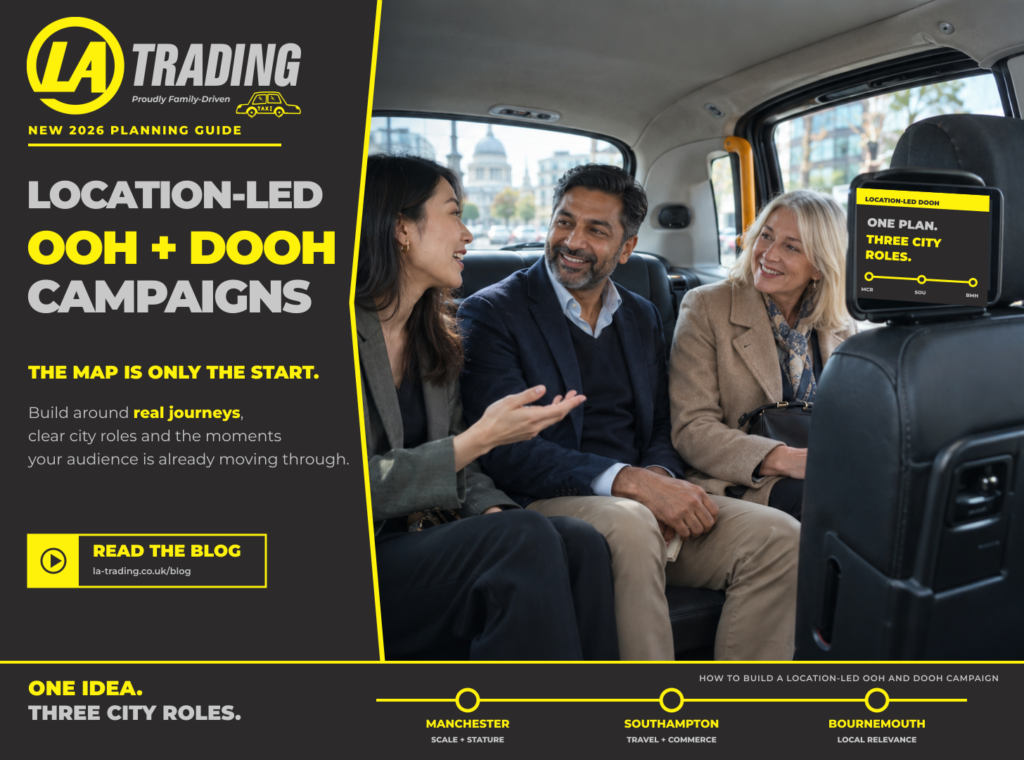
Manchester: build scale and stature
Manchester suits campaigns that need a major-city presence: launches, entertainment, finance, property, recruitment, hospitality and national brand activity.
According to LA Trading’s current location overview, Manchester sits within its Tier 1 plan, starting with 200 screens and an indicated 1.2 million-plus monthly views per city. That makes it a natural lead market for broad awareness and campaign fame.
The creative job: make the brand unmistakable. Keep the proposition short, visually distinctive and connected to the wider OOH idea.
Southampton: connect commercial and travel moments
Southampton brings together retail, business travel, universities, hospitality, events and onward journeys. LA Trading lists it within its Tier 2 plan, starting with 150 screens and an indicated 900,000-plus monthly views per city.
The creative job: recognise why people are moving. A passenger heading to a meeting may need reassurance or credibility; somebody heading into the city may respond better to entertainment, food or retail discovery.
Bournemouth: make relevance feel local
Bournemouth’s visitor economy, hospitality venues, professional community and busy seasonal calendar create a different rhythm. LA Trading places it within its regional plan, starting with 100 screens and an indicated 600,000-plus monthly views per city.
The creative job: use timing well. Summer weekends, conferences, university terms and event periods can change which message feels most useful.
The lesson is simple: Manchester, Southampton and Bournemouth should not be three copies of the same booking. They should be three connected roles within one campaign.
Let OOH create recognition—and DOOH continue the journey
Classic OOH remains brilliant at creating public visibility. Large formats can announce the idea, establish confidence and make a brand feel present in the city.
In-taxi DOOH can complement that work from a closer passenger environment. The roadside message may introduce the brand; the screen inside the journey can add detail, reinforce the visual memory or invite an action.
Think of it as a handover:
Street: create recognition.
Seat: deepen the message.
Screen or store: make the next step easy.
No channel is being asked to do everything. Each one does the job its environment supports best.
Build one campaign idea with local variations
Localisation does not mean rebuilding the campaign every time a taxi crosses a boundary.
Keep the distinctive assets consistent:
Then adapt the useful layer:
The brand stays recognisable. The message earns its place.
Decide measurement before the campaign starts
Route’s guidance for OOH measurement recommends aligning the data request with the campaign objective and recognising differences across time, region, format and environment. That is useful planning discipline even when different formats use different measurement approaches.
Before launch, agree which evidence matters:
booked locations and campaign dates
creative versions used
proof-of-play delivery
completed and failed plays
QR scans or landing-page visits, when included
brand, search, footfall or sales measures supplied by the wider campaign
A play is not automatically a person. A scan is not the whole value of awareness. Clear definitions protect credibility and make the next plan better.
The costly location is the one without a purpose
The best 2026 media plans will not choose between national stature and local relevance. They will build both—deliberately.
So before another city gets added because somebody said, “We should probably be there,” give it a job. Decide the audience moment, the message and the evidence you expect back.
LA Trading can help agencies and brands turn a campaign brief into a practical in-taxi DOOH location plan across Manchester, Southampton, Bournemouth and the wider network.
Send us your audience, campaign dates and priority locations. We’ll show you where the journey can add value.