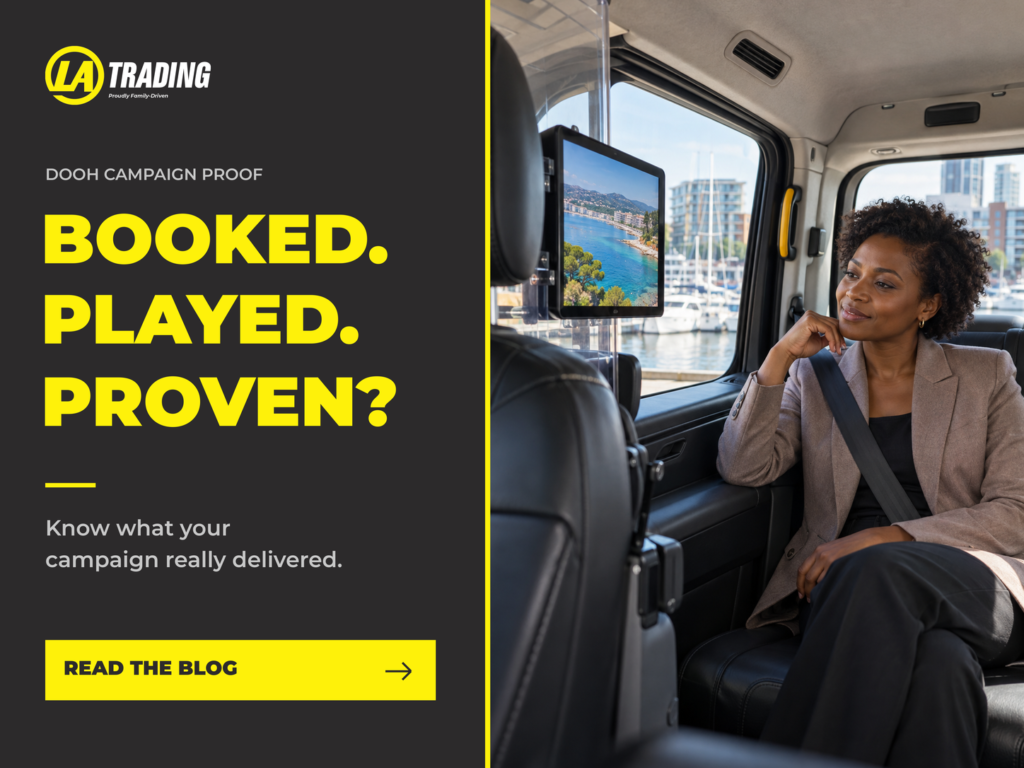
For marketing directors and agencies planning into 2027, the opportunity is to make reporting useful before the campaign begins. Agree the evidence early and you can spot delivery gaps while there is still time to respond.
Here are four questions worth putting in the brief.
starting, finishing, or both?
A scheduled slot, a playback start and a completed advert describe different things. Your report should make those distinctions clear, with the creative version, screen identifier and timestamp available where supported.
“Plays delivered” becomes much more useful when everyone agrees what qualifies.
2. Delivered against which promise?
A large total can look reassuring while hiding a shortfall against the booking.
For a campaign bought on an agreed number of qualifying plays, use:
Delivery rate = qualifying plays delivered ÷ booked plays × 100
Here is an illustrative example—not an LA Trading campaign result:
| Measure | Example |
|---|
| Booked completed plays | 10,000 |
| Recorded playback starts | 10,200 |
| Verified completed plays | 9,600 |
| Delivery against the booking | 96% |
The starts exceeded 10,000. The completed delivery did not.
If your booking uses another basis, agree the appropriate calculation upfront. Also request a breakdown by booked city and campaign period: extra delivery somewhere else may not fulfil the original brief.
3. What does “completed” actually prove?
Ask whether completion is directly logged or inferred, and how interrupted playback is handled.
In the example above, 9,600 completed plays from 10,200 starts gives a 94.1% playback completion rate. That measures something different from the 96% booking delivery rate.
Neither figure proves that a passenger watched the entire advert.
For in-taxi DOOH, playback evidence alone cannot establish that the vehicle was occupied, that someone noticed the screen, or that a sale followed. Audience estimates need their own methodology; attention and commercial outcomes need separate evidence.
That clarity helps buyers understand exactly what their investment delivered.
4. What happens when the numbers do not match?
Before launch, agree:
When delivery updates will arrive.
How missing logs, failed playback and duplicate records are treated.
Who investigates discrepancies.
What remedy applies if delivery falls short.
Missing data should be labelled as missing—not quietly counted as success or failure.
A report becomes actionable when it explains exceptions and the next step, rather than leaving your team to solve a spreadsheet mystery.
Give your wider OOH plan stronger evidence
OOH gives brands valuable physical presence. In-taxi DOOH adds an opportunity to continue the message inside the passenger journey.
At LA Trading, that means advertising on screens inside UK taxis. Understanding delivery helps agencies assess this environment alongside the wider media plan, while keeping playback, audience estimates and business outcomes clearly distinguished.
The opportunity you risk missing is the chance to correct a problem during the campaign. Once the launch window has passed, a beautifully formatted report cannot bring it back.
Before the creative gets signed off and the calendar fills up, give the reporting a quick audition.
Request a sample campaign report from LA Trading. Put “Sample campaign report” in the subject and tell us your intended city and campaign objective.
Your next budget meeting may still need coffee. It should not need a detective.
SEO fields
| Field | Exact copy |
|---|
| Blog title | From Proof-of-Play to Campaign Proof: What Advertisers Should Ask For |
| H1 | From Proof-of-Play to Campaign Proof: What Advertisers Should Ask For |
| SEO keyphrase | From Proof-of-Play to Campaign Proof: What Advertisers Should Ask For |
| Meta description | From Proof-of-Play to Campaign Proof: What Advertisers Should Ask For. Understand DOOH delivery rates, completed plays and reporting. Request a sample report. |
| URL slug | /from-proof-of-play-to-campaign-proof-what-advertisers-should-ask-for/ |
| Suggested tags | OOH, DOOH, In-Taxi Advertising, Campaign Reporting, Media Planning |
| CTA button | Request a sample campaign report |
Before you book the screens, ask to see the receipts
Picture your next campaign review. Someone asks, “Did we get what we booked?” You have the answer, the evidence and enough time left to drink your coffee while it’s still hot.
That starts before launch. Waiting until the campaign ends means missing the chance to question a gap, correct delivery or make a better decision while it still matters.
Planning OOH or DOOH? Give the reporting five minutes before you give the campaign the green light.
Request a sample campaign report from LA Trading to see what you should be asking for. Put “Sample campaign report” in the subject and tell us your target city.
Bring your questions. Leave the detective work out of your next debrief.