Event marketers obsess over arrival
And understandably so.
Brands spend serious time thinking about:
- venue signage
- sponsor visibility
- exhibition stands
- activations
- stage branding
- screens
- giveaways
- hospitality
- social coverage
OOH can amplify that beautifully around the wider location.
But then thousands of people leave.
At roughly the same time.
Thinking about what they just experienced.
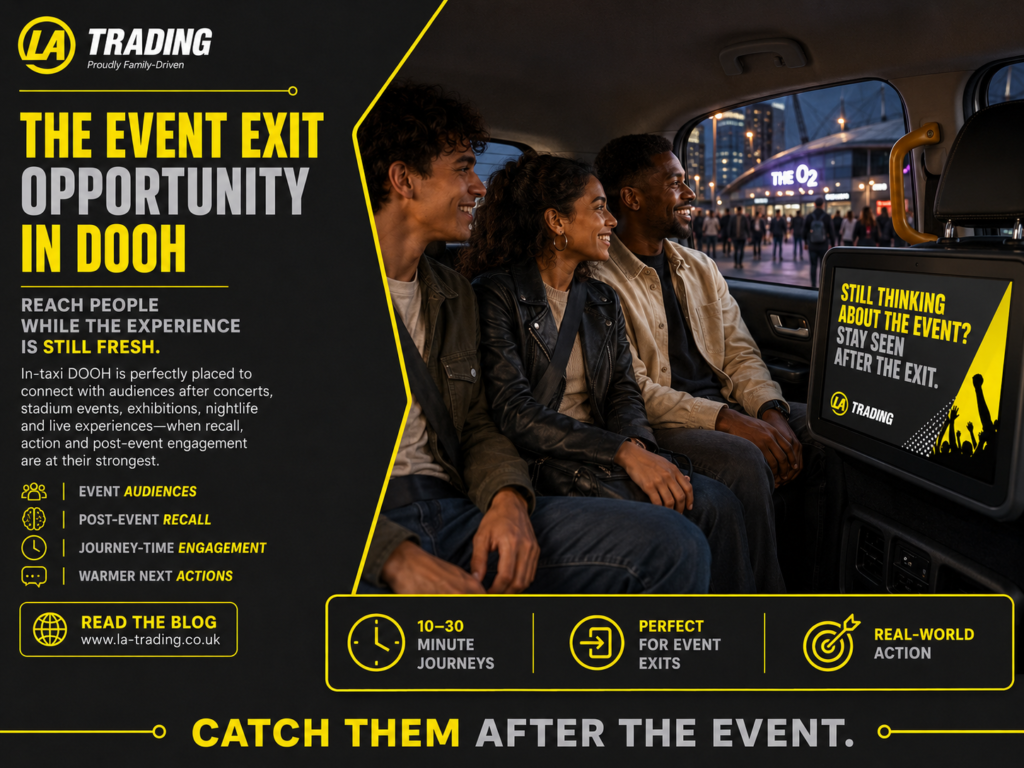
That journey away from the event is media territory too.
The exit audience is different from the arrival audience
Before an event, people are anticipating.
After an event, they are processing.
They are asking:
Who did I meet?
Which company was that?
Should I follow them?
What was that product called?
Do I actually need to book that?
That makes the journey afterwards strategically interesting.
The advertising job has changed.
You no longer necessarily need to introduce the idea.
You need to help the audience remember what just happened.
Think of it as the encore
A great concert does not finish and immediately become irrelevant.
Neither should a strong event campaign.
OOH can dominate the public environment around a major event.
DOOH can update messaging as the event unfolds.
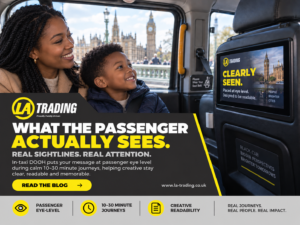
In-taxi DOOH can potentially extend the campaign into onward journeys.
That could mean:
Before event:
“See us at Stand 42.”
During event:
“Come and experience the product.”
After event:
“Good meeting you. Here’s what happens next.”
Same campaign.
Different moment.
Much smarter.
Sponsors should particularly care about this
Sponsorship can become very logo-heavy.
Logo on stage.
Logo on ticket.
Logo on lanyard.
Logo on email.
Logo on another logo.
There is nothing wrong with that visibility.
But clever sponsors increasingly have the opportunity to make partnerships feel more useful and content-led.
Recent 2026 OOH activity supports that broader direction. For example, Limited Space and Hello! launched an editorial DOOH content partnership, while Olympic highlights were distributed across Ocean’s DOOH network through a commercial partnership involving Aldi.
The lesson is not that everyone needs sports highlights.
The lesson is:
Partnership media can do more than display a badge.
What could an event-exit campaign actually say?
Imagine a business conference.
Taxi screen:
“GOOD EVENT?”
Now turn the notes into action.
Or a food festival:
“FOUND A NEW FAVOURITE?”
Book the table before everyone else does.
Property exhibition:
“SAW SOMETHING YOU LIKED?”
Take another look on the way home.
Recruitment event:
“MET YOUR NEXT EMPLOYER?”
Make the first move before Monday morning.
Simple.
Relevant.
Timed to the moment.
The commercial opportunity for event organisers
There is another angle here.
The journey home can become additional sponsorship inventory.
An organiser could work with a transport or DOOH partner to create:
Official Journey Partner
Event Highlights Partner
Visitor Welcome & Return Partner
After-Event Offer Partner
Local Hospitality Partner
Suddenly the commercial relationship extends beyond the venue walls.
That can create additional value for:
- sponsors
- venues
- destinations
- hospitality businesses
- local advertisers
- attendees
And importantly, it does not need to compete with the main OOH campaign.
It can complement it.
The major formats create visibility around the event.
The journey environment continues the conversation.
Why this fits 2026 particularly well
OOH continues to grow globally, and DOOH remains a major engine of that expansion. At the same time, partnerships between property owners, retailers, publishers and media networks are creating increasingly varied real-world media environments.
The medium is becoming less about:
“Where can we put another screen?”
and more about:
“What is happening around this screen, and why does this moment matter?”
Events are full of those moments.
Arrival.
Excitement.
Discovery.
Conversation.
Departure.
Follow-up.
Every one has a different creative opportunity.
The FOMO problem
The best event windows are temporary.
That is what makes them valuable.
Everyone is there now.
Everyone leaves now.
The buzz exists now.
Wait three weeks and the moment has gone.
So if brands want to own the journey surrounding an event, the planning needs to happen before everybody else suddenly decides they want the same dates.
Real FOMO.
Not a red flashing countdown timer.
Final thought
Everyone talks about getting people through the door.
Maybe marketers should spend a little more time thinking about what happens when they walk back out.
Because the event may be finished.
But the conversation is not.
The attendee is still thinking.
Still travelling.
Still talking.
Still deciding.
And very possibly…
still waiting for their taxi.
🚕 Planning an event, sponsorship or OOH campaign that deserves an encore?
Talk to LA Trading about extending the experience into the passenger journey.
The venue may close at 10pm. Your campaign doesn’t necessarily have to