Transit advertising has always had something other media wants
People.
Lots of them.
Moving through the real world.
Rail stations, buses, airports, roads, taxis and transport hubs are woven into everyday life.
OOH has understood this for decades.
Transport environments offer advertisers access to audiences while life is actually happening rather than while somebody is sitting in a targeting segment labelled “Urban Professional 25–44”.
That distinction matters.
Because customers are not demographic profiles when they are travelling.
They are people going somewhere.
And destination changes mindset.
Someone heading to an airport behaves differently from somebody heading to dinner.
Someone travelling to a meeting thinks differently from someone travelling home after a concert.
Movement creates context.
Transit advertising has always had access to that context.
Digital technology is now giving advertisers more ways to use it.
The taxi is becoming a media environment in its own right
Taxi advertising is sometimes discussed as though the vehicle itself is the advertising format.
But there are several different environments within taxi media.
Exterior branding performs a public-facing OOH role.
Taxi-top formats create moving visibility.
And internal digital screens create something else entirely:
a place-based passenger media environment that happens to move.
That distinction is important.
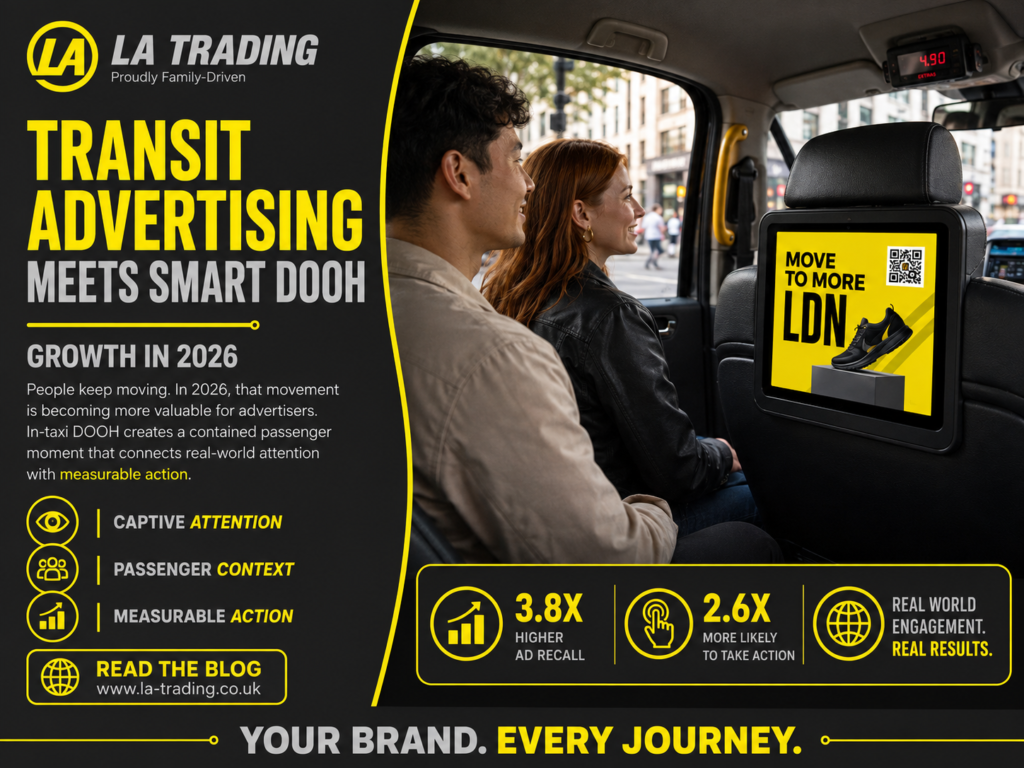
At LA Trading, the digital screens are positioned inside taxis for passengers, with the company describing journeys of around 10–30 minutes as the core environment for its network.
So while the taxi moves through the city, the passenger has a relatively stable media environment inside it.
That combination is unusual.
Moving location.
Stationary viewer.
Digital screen.
Real journey.
For OOH planners, that’s an interesting piece of inventory.
Bigger OOH plus smaller passenger environments can work beautifully together
Picture a major entertainment launch.
A giant city-centre OOH execution creates the spectacle.
Rail and transport formats reinforce awareness across commuter routes.
Digital street furniture adds frequency.
Then somebody gets into a taxi.
Inside, the same campaign could become more conversational.
Perhaps the trailer appears.
Perhaps the release date is reinforced.
Perhaps the message adapts around the city.
Perhaps the passenger gets a useful next step.
Same campaign.
Different scale.
The public-facing OOH does not become less important because another format exists.
It becomes the anchor.
Transit and passenger environments give planners more ways to develop the idea around it.
That is how strong media ecosystems grow.
They add formats that do different jobs.
OOH doesn’t need another reach contest
Marketing occasionally behaves like a school playground.
“My channel has more impressions than your channel.”
“Yes, but mine has better engagement.”
“Our CPM is lower.”
“Well, our acronym has more letters.”
Eventually somebody should probably confiscate the PowerPoint.
The more useful conversation is about roles.
A roadside site may be perfect for mass awareness.
A spectacular digital screen may make a campaign culturally visible.
Rail may deliver high commuter frequency.
Retail environments may connect with purchase behaviour.
In-taxi DOOH may provide a more contained passenger moment.
Nobody needs to crown one universal winner.
Good media planning is about assembling the right combination.
That is especially relevant as OOH becomes increasingly connected with broader omnichannel buying and measurement systems.
Why movement itself is becoming valuable
We often talk about audience location.
But location only tells us where someone is now.
Transport tells us something else:
They are going somewhere.
That creates a powerful planning distinction.
A city-centre audience might include residents, workers, visitors, diners, shoppers, students and tourists.
A passenger journey can add another layer of context.
Morning travel.
Airport transfer.
Night-time economy.
Hotel journey.
Retail trip.
Event travel.
Business movement.
This does not mean advertisers should behave like overenthusiastic detectives.
Responsible audience planning matters.
It means understanding the environment and moment around the media.
A useful restaurant advert before dinner.
A hotel message during visitor travel.
An entertainment campaign during evening movement.
A professional service during business travel.
A retail promotion before arriving in a shopping district.
Relevance can be simple.
It doesn’t need to know what you had for breakfast.
Why big OOH players should watch passenger DOOH
Because the OOH market is expanding in directions that make the entire category more versatile.
Moving and dynamic media is prominent enough that OAAA released new 2026 guidance focused specifically on the formats, measurement capabilities and planning opportunities around it.
The opportunity for established OOH businesses is therefore not merely more inventory.
It is more ways to solve client briefs.
A client asking for nationwide fame may need large formats.
A client launching around specific urban audiences may need transit.
A hospitality brand might value passenger environments.
A regional launch may require local coverage.
A campaign needing multiple physical touchpoints could use several.
The larger the OOH toolkit becomes, the harder it is for advertisers to treat outdoor as a single blunt channel.
That is good for everyone in the industry.
The FOMO is not about buying taxis
Here is the important part.
The opportunity is not:
“Quick! Everyone buy taxi advertising before Thursday!”
That would be ridiculous.
The FOMO is strategic.
If audiences are spending meaningful parts of their lives moving between places, how much of your client’s media plan understands those moments?
Not simply the destination.
Not simply the street.
The movement between them.
Transport advertising has always occupied that territory.
DOOH is now giving it greater creative flexibility.
Passenger screens add another type of environment.
And media planners who understand the differences between those environments have more options than those who simply categorise everything as “outdoor”.
What should an agency ask before adding transit DOOH?
Not:
“Can we add another screen?”
Ask:
“What can this environment do that our other placements cannot?”
Perhaps it offers more time.
Perhaps it offers geographic relevance.
Perhaps it provides a stronger environment for video.
Perhaps it creates local reinforcement.
Perhaps it gives a campaign another way to appear during travel.
If there isn’t a good answer, don’t buy it.
That may sound like unusual advice from a media owner.
But a poor placement helps nobody.
The objective should be to make the overall OOH plan stronger.
Final thought: follow the people
Marketers love predicting the future.
AI.
Automation.
Programmatic buying.
Connected commerce.
New screens.
New datasets.
New platforms.
All important.
But one of the smartest media strategies in 2026 may still begin with an extremely old observation:
People go places.
They leave home.
They work.
They shop.
They travel.
They celebrate.
They visit.
They return.
OOH exists inside that behaviour.
Transit advertising gets even closer to the movement itself.
And DOOH gives that environment new possibilities.
So perhaps the next big opportunity isn’t finding another place to put an advert.
Perhaps it is understanding the places people already spend their lives moving through.
And if part of that journey happens in the back of a taxi?
Well.
We know a few screens.
Planning a wider OOH or transit campaign? Talk to LA Trading about where in-taxi DOOH could genuinely add value. We’ll show you the passenger environment, network options and campaign possibilities — and if it fits the brief, brilliant. If it doesn’t, at least we’ll have saved everyone another unnecessary 47-slide deck.