Frequency should build recognition, not boredom
Traditional media planning often focuses on how many times an audience is likely to encounter a campaign.
That remains important.
However, frequency becomes more valuable when each exposure adds something rather than merely repeating the first message.
A passenger might encounter the same taxi-screen network during several journeys. Showing the identical creative every time may still reinforce awareness, but rotating complementary executions can create a richer campaign experience.
The brand remains familiar.
The content feels fresh.
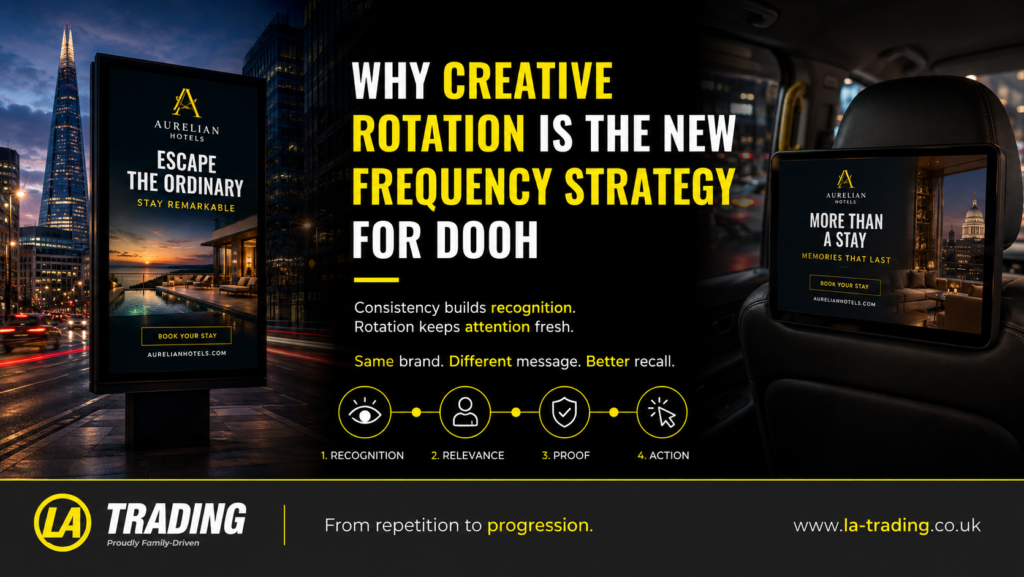
This is creative rotation.
One campaign can contain several useful messages
Most businesses have more than one thing worth saying.
A hotel might want to promote:
- Weekend stays
- Afternoon tea
- Events
- Corporate bookings
- A seasonal package
A retail brand may want to feature:
- A hero product
- A launch
- A customer benefit
- A local store
- A time-sensitive offer
A venue may need to communicate different dates, experiences or audience reasons to attend.
Trying to include everything in one execution usually produces a design with tiny text, six competing messages and a QR code clinging to the corner for emotional support.
Creative rotation solves this by distributing the information.
Each advert gets one job.
The campaign performs several.
Consistency does not require identical creative
A rotating campaign should still feel recognisably connected.
The audience needs stable brand signals such as:
- Logo placement
- Typography
- Colour palette
- Tone of voice
- Campaign line
- Visual style
- Product shape
- Recognisable characters
These elements become the thread joining the executions.
The message can then change according to location, time, audience mindset or campaign stage.
This gives brands variety without sacrificing recognition.
Think of it as a television series rather than a collection of unrelated clips. Every episode is different, but nobody is confused about what they are watching.
Rotate by time of day
Different parts of the day create different customer needs.
Morning passengers may be thinking about work, coffee, travel or the day ahead.
Afternoon passengers may be considering shopping, meetings or errands.
Evening passengers may be more receptive to food, entertainment, leisure and hospitality.
A DOOH campaign could adapt its creative accordingly.
For example, a restaurant might use:
- Morning: “Tonight’s table can be tomorrow’s best decision.”
- Afternoon: “Still pretending you know what you’re having for dinner?”
- Evening: “You are already out. We have done half the work.”
The brand remains the same, but the message respects the moment.
Rotate by location
Location-sensitive messaging can make a national or regional campaign feel locally useful.
A brand could adjust:
- Nearby venue information
- Store directions
- Local product availability
- Event dates
- Regional headlines
- City-specific offers
- Destination-based recommendations
This is particularly relevant for taxi journeys because the passenger is physically moving through a defined area.
The advert can connect the wider brand story to the immediate city, destination or local opportunity.
Hyper-local relevance is already central to LA Trading’s in-taxi advertising proposition, allowing campaigns to focus on particular areas and customer environments.
Rotate through the customer journey
Creative can also change according to what the audience needs to understand.
Execution one: recognition
Introduce the brand with a strong visual and memorable headline.
Execution two: relevance
Explain why the product, venue or service matters.
Execution three: proof
Present a customer benefit, testimonial, achievement or useful detail.
Execution four: action
Give the audience a clear next step.
This approach prevents the campaign from trying to generate awareness, explain the entire proposition, prove credibility and close the sale in one screen.
It also means repeated exposure becomes progressive.
The audience learns something new while the brand becomes increasingly familiar.
Rotation can support wider OOH planning
Creative rotation should not be viewed as a digital trick disconnected from the rest of the media plan.
It can help OOH advertisers extend campaign ideas across formats.
A major outdoor placement may carry the boldest campaign message.
In-taxi DOOH can rotate supporting stories, product details, local prompts or direct-response executions.
The relationship is complementary:
- OOH creates scale.
- DOOH introduces flexibility.
- Creative rotation keeps the campaign moving.
- A clear call to action helps convert interest.
This allows the brand to use each format according to its strengths.
The rise of flexibility in DOOH
DOOH continues to become a larger part of the wider OOH market. The World Out of Home Organization reported that digital represented around 47% of global OOH expenditure in 2025 and forecast continued growth during 2026. IAB UK also expects digital formats to account for a growing majority of UK OOH expenditure over the coming years as programmatic capability, measurement and omnichannel integration mature.
That growth is not only about replacing printed formats with screens.
It is about giving advertisers more ways to manage timing, relevance and creative delivery.
The opportunity is wasted when a flexible screen is treated like a poster that happens to glow.
Do not rotate without a reason
More versions do not automatically create a better campaign.
Creative rotation should have a clear strategic purpose.
Before creating twelve executions because someone discovered the duplicate button, decide what the rotation is intended to improve.
Possible objectives include:
- Maintaining audience interest
- Supporting multiple products
- Matching time-sensitive demand
- Creating local relevance
- Testing headline approaches
- Building a sequential story
- Separating awareness from action
- Supporting seasonal changes
Every execution should contribute to one campaign idea.
Otherwise, rotation becomes clutter wearing a digital hat.
A practical creative-rotation framework
Brands can begin with four questions:
1. What must remain consistent?
Identify the brand elements that should appear across every version.
2. What can change?
Choose the message, offer, location detail, image or call to action that will rotate.
3. Why is it changing?
Link each variation to a customer need, time, place or campaign stage.
4. What should the audience do?
Ensure every execution has a clear purpose, even when the main objective is awareness.
This framework keeps creative production focused and prevents unnecessary complexity.
Give audiences another reason to notice
Frequency is not simply the number of times a brand appears.
It is the number of useful opportunities a campaign creates to become recognised, understood and remembered.
Creative rotation allows brands to repeat their identity without repeating themselves.
That is an important difference.
After all, your audience may be happy to see your campaign again.
They just do not need the advertising equivalent of someone saying, “As I mentioned in my previous email.”
Planning a DOOH campaign with more than one message to communicate? Speak to LA Trading about building a structured creative rotation that complements your wider OOH activity and keeps every passenger interaction purposeful.