The result?
The audience is knackered.
People are not short of advertising. They are surrounded by it.
They wake up to it. Scroll through it. Walk past it. Hear it. Skip it. Mute it. See it again. Then get followed around the internet by the same pair of shoes they looked at once during a moment of weakness.
So perhaps the smartest question for 2026 is not:
How do we shout louder?
It is:
Where can the brand be heard properly?
And that is where the taxi becomes interesting.
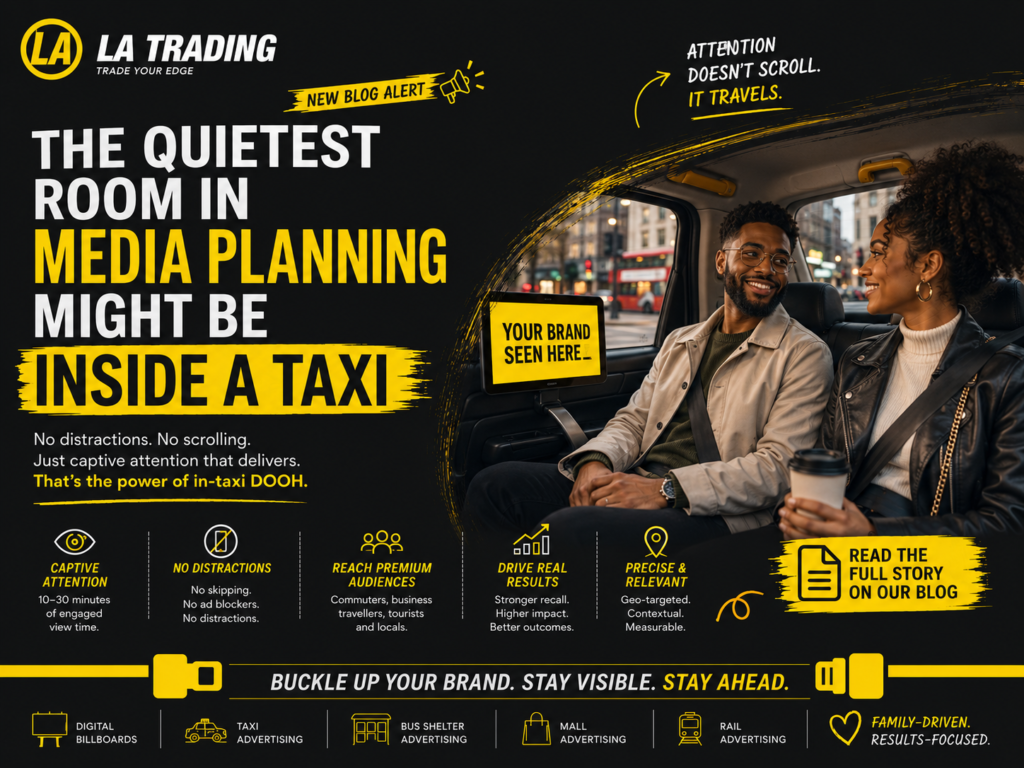
Because inside a taxi, something rare happens.
The passenger pauses.
Not completely, of course. They may still check their phone. They may still look out of the window. They may still silently judge the route even though the driver definitely knows the city better than they do.
But compared with the chaos outside, the taxi is a more focused environment.
A small room on wheels.
A moving media space.
A moment between places.
And for OOH brands looking to add a sharper DOOH layer in 2026, that moment is becoming increasingly valuable.
OOH creates presence. DOOH creates the closer look.
OOH is brilliant because it gives a brand public confidence.
A strong outdoor campaign says, “We are here.”
It brings scale.
It creates familiarity.
It puts the brand into the real world where people live, commute, shop, travel, socialise, and make decisions.
That matters.
In fact, it matters more now because so much advertising feels temporary online. A brand in the physical world often feels more established, more visible, and more culturally present.
But once that public presence has been created, brands can go further.
They can guide attention into a more focused environment.
That is where in-taxi DOOH works so well as a companion to OOH.
The outdoor campaign creates recognition.
The in-taxi screen gives the passenger time to properly take it in.
This is not about choosing one over the other.
It is about building a better sequence.
Public fame first.
Passenger focus next.
Action after that.
Why attention feels different when people are seated
A seated passenger is not the same as a passing pedestrian.
That sounds obvious, but media plans sometimes forget it.
A person walking through a busy street is processing everything at once: traffic, signs, messages, weather, people, noise, notifications, and the terrifying possibility of making accidental eye contact with a clipboard fundraiser.
Their attention is real, but brief.
A taxi passenger is in a different state.
They have entered the vehicle.
They are on a route.
They have a window of time.
They are still connected to the outside world, but they are not physically moving through it.
That changes the attention dynamic.
The screen becomes part of the journey rather than part of the clutter.
A brand message can repeat.
A story can unfold.
A QR code can be scanned.
A local offer can make sense.
A campaign can move from awareness into action.
That is why in-taxi DOOH is not just “another screen.”
It is a screen with context.
The emotional advantage of the in-between moment
Some of the best advertising does not arrive at the loudest moment.
It arrives at the right moment.
Taxi journeys are full of in-between moments.
Between work and dinner.
Between the hotel and the meeting.
Between the airport and the city.
Between the venue and home.
Between “I am definitely not staying out late” and “Why am I ordering chips at midnight?”
These moments matter because people are often mentally open.
They are thinking about where they are going.
What they need.
What they might buy.
Who they are meeting.
What they forgot to do.
Where they should go next.
That creates a subtle but powerful opportunity for brands.
A message in that moment can feel useful rather than intrusive.
A restaurant ad before a night out.
A retail message near a shopping route.
A financial service during business travel.
A venue promotion when passengers are moving through the city.
A QR code offer when someone has time to scan it properly.
This is where DOOH becomes more human.
It is not just targeted.
It is timed.
Why 2026 media plans need calmer spaces
The marketing world has become obsessed with attention, but attention is not one single thing.
There is forced attention.
There is accidental attention.
There is emotional attention.
There is useful attention.
There is “I only watched this ad because the skip button had not appeared yet” attention.
Not all of those are equal.
In 2026, brands need to think more carefully about the quality of the moment, not just the size of the audience.
A huge audience in a distracted state may create awareness.
A smaller audience in a high-focus environment may create stronger recall and better action.
The best campaigns use both.
That is why OOH and in-taxi DOOH can work beautifully together.
OOH gives the campaign scale.
In-taxi DOOH gives it focus.
OOH makes the brand visible.
In-taxi DOOH gives the brand a chance to be understood.
OOH starts the conversation.
In-taxi DOOH gives the passenger a reason to continue it.
A media space that does not feel like an interruption
One of the biggest challenges in modern advertising is that people have become skilled at avoiding interruptions.
They skip ads.
They scroll past them.
They use ad blockers.
They close pop-ups like they are swatting digital flies.
But in-taxi DOOH does not have to feel like an interruption.
The passenger is already in the vehicle.
The screen is part of the environment.
The message can be designed to suit the journey, not disrupt it.
That is a crucial difference.
Good in-taxi creative should not shout at people.
It should meet them where they are.
Clear message.
Strong visual.
Simple action.
A useful reason to scan.
A memorable line.
A local connection.
Something that respects the fact the passenger is not a “target”; they are a person on their way somewhere.
That human approach is what makes the format feel modern.
The FOMO bit: while everyone fights for the feed, the taxi is wide open
Online advertising is not going away.
It still matters.
Search matters.
Social matters.
Video matters.
Retargeting matters when it is done with common sense and not the emotional intensity of a clingy ex.
But the feed is crowded.
Every brand is fighting for the same seconds.
The taxi journey gives brands a different kind of opportunity.
It is physical.
It is local.
It is measurable.
It is flexible.
It can connect with mobile through QR codes, NFC, landing pages, offers, app downloads, store finders, booking pages, and campaign-specific experiences.
For brands already spending on OOH, this is not a random add-on.
It is a logical next step.
The audience has already seen the brand in public.
Now they can meet it again in a more focused place.
The campaign does not just appear.
It follows the journey.
How brands can use the quiet room properly
The best in-taxi DOOH campaigns are not overcomplicated.
They are clear.
They understand the passenger.
They match the context.
They make action easy.
A good campaign might use:
A simple headline that can be understood quickly.
A visual that connects with the wider OOH campaign.
A QR code that gives passengers a reason to scan.
A location-aware message.
A time-sensitive offer.
A brand story broken into short, memorable creative.
A direct route to booking, buying, visiting, downloading, or enquiring.
The goal is not to cram a full brochure onto a screen.
Nobody gets into a taxi hoping to read a dissertation.
The goal is to create a moment that feels easy to take in and easy to act on.
Final thought
The quietest room in media planning might be inside a taxi because it gives brands something rare: attention with a little bit of breathing room.
OOH gives brands the public stage.
In-taxi DOOH gives brands the moving room.
Together, they help campaigns feel bigger, smarter, and more connected to real behaviour.
In 2026, the brands that win will not simply be the ones shouting the loudest.
They will be the ones showing up in the right places, at the right time, with the right message, in a way people actually want to receive.
That is not old-school advertising.
That is real-world media growing up.
If your campaign already looks good in the street, imagine what it could do inside the journey. Speak to LA Trading about in-taxi DOOH and turn your next OOH campaign into something passengers can see, scan, remember, and act on.