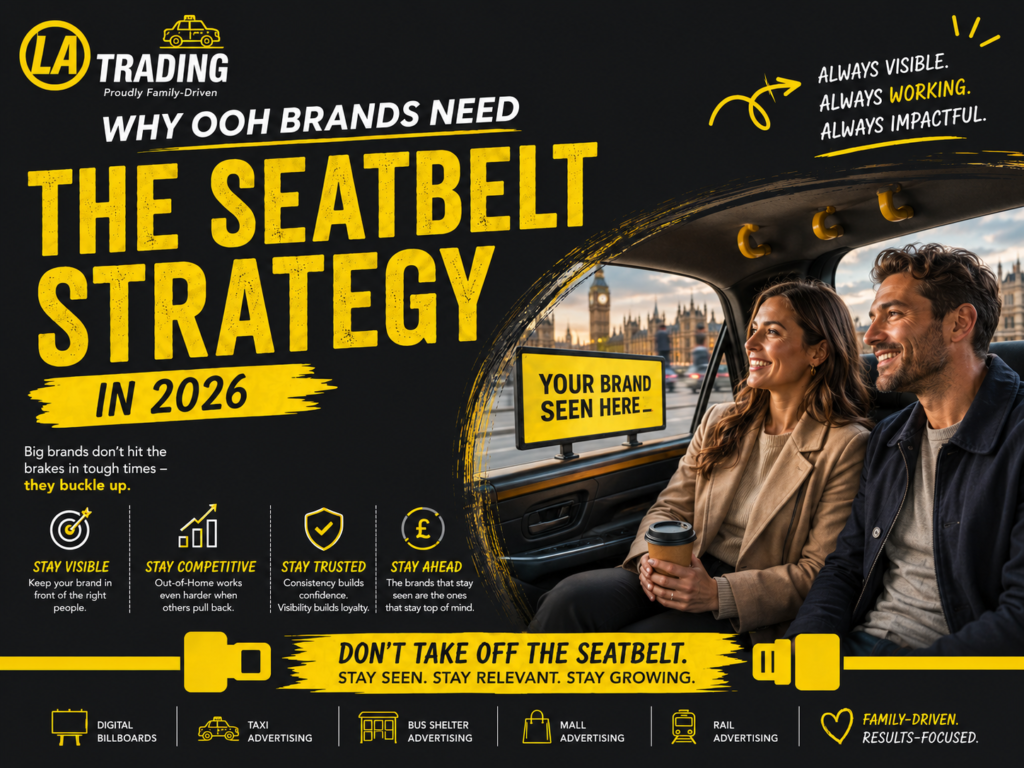
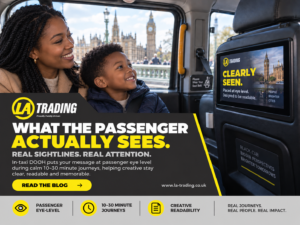
Why OOH brands need the seatbelt strategy is because in 2026, being seen is only the start. The real opportunity begins when your audience sits down, settles in, and finally has the breathing room to absorb a message properly.
Let’s go through why properly…
There is a moment in every taxi journey that marketers should probably be paying more attention to.
The door shuts.
The seatbelt clicks.
The outside world becomes slightly quieter.
And for once, your audience is not walking past, scrolling past, skipping past, muting, closing, deleting, or pretending they “didn’t see that email.”
They are seated.
They are present.
They are going somewhere.
That is what we call the seatbelt strategy.
It is not a replacement for brilliant OOH. Far from it. Big outdoor campaigns still do what they have always done best: create presence, fame, scale, and that wonderful “we are absolutely a serious brand” feeling.
But in 2026, the smartest campaigns are not stopping at public visibility.
They are asking a better question:
What happens after someone sees us?
Because when your campaign has already made an impression on the street, on a roadside panel, near a station, or across a high-footfall area, the next win is not always another shout.
Sometimes it is a better-timed conversation.
From public fame to personal focus
OOH is excellent at creating the big moment.
It tells the market you are here. It puts your brand into the real world. It gives your campaign scale and confidence.
But people do not always act the first time they see something.
They may notice it.
They may like it.
They may half-remember it.
They may even say, “That’s clever,” which in British terms is basically a standing ovation.
Then life carries on.
They cross the road.
They check a message.
They think about dinner.
They forget the thing they definitely told themselves they would remember.
That is not a failure of OOH.
That is human behaviour.
The opportunity for 2026 is to build a second environment where that awareness can settle into attention.
That is where in-taxi DOOH becomes powerful.
Inside a taxi, your brand is no longer competing with a thousand passing distractions. The passenger is in a contained space, during a journey, with time to notice what is in front of them.
That is the seatbelt moment.
Why the taxi journey changes the media mood
Not all attention feels the same.
There is “I saw it for half a second while looking for my train platform” attention.
There is “I noticed it while trying not to spill coffee on myself” attention.
Then there is “I am sitting down for 10 to 30 minutes and this screen is right in front of me” attention.
That third one is different.
It is calmer.
It has dwell time.
It gives the message space to breathe.
It gives the creative more chance to land.
And because passengers are already in motion, it allows brands to connect messaging with real-life behaviour: where someone is travelling, what they might be doing next, what part of the day they are in, and what action would make sense in that moment.
A restaurant offer before dinner.
A hotel message on an airport route.
A retail push near shopping districts.
A finance brand during business travel.
An entertainment launch while people are heading into the city.
That is not just advertising.
That is timing with a seatbelt on.
The 2026 shift: campaigns need a route, not just a location
Traditional media planning often focuses on where the audience is.
That still matters.
But 2026 planning needs to ask where the audience is going.
People are not static. They move between work, home, events, shops, restaurants, airports, hotels, venues, appointments, and nights out that were originally meant to be “just one drink.”
The best media plans understand that movement.
OOH gives brands the power to appear in public spaces.
In-taxi DOOH gives brands the chance to travel with people after that public moment.
It helps extend a campaign from the street into the journey, from awareness into attention, and from visibility into response.
This matters because modern campaigns are under pressure to prove more than reach.
Brands want fame, yes.
But they also want engagement.
They want memory.
They want action.
They want someone to scan, search, visit, book, download, enquire, walk in, or at least remember them when the decision moment arrives.
A seatbelt strategy supports that by creating a focused bridge between the public world and the personal next step.
Why this works especially well for OOH-led brands
OOH brands already understand the value of showing up in the real world.
They understand physical presence.
They understand brand fame.
They understand that not every important moment happens on a phone screen.
That is exactly why in-taxi DOOH fits so naturally alongside OOH.
It does not undermine the wider campaign.
It strengthens it.
Think of OOH as the big stage.
Think of in-taxi DOOH as the closer conversation afterwards.
The first builds awareness.
The second gives people time to absorb, interact, and act.
Together, they create a more complete campaign journey.
And the best part is that this does not need to feel complicated.
A brand can use the same campaign idea, adapt the message for a seated passenger environment, add a QR code, change creative by location or time, and guide people towards a next step that feels natural.
No awkward over-selling.
No shouting.
No “PLEASE BUY THIS NOW” energy.
Just smart media placement doing its job properly.
FOMO alert: the passenger moment will not stay underused forever
Every media channel has a period where the brands that spot it early get the biggest creative advantage.
There was a time when social felt fresh.
A time when influencer marketing felt new.
A time when QR codes came back from the dead like they had been doing press-ups in secret.
In-taxi DOOH is moving into that opportunity zone now.
It combines real-world trust with digital flexibility.
It gives campaigns a high-attention environment.
It creates action points through QR, NFC, offers, landing pages, store finders, app downloads, bookings, or campaign-specific experiences.
And crucially, it catches people when they are not just passing a message, but sitting with it.
For brands already investing in OOH, that is not a small addition.
It is a smart extension.
The danger is not that your campaign will fail without it.
The danger is that another brand in your category gets into that passenger moment first.
And suddenly, they are the one being remembered when the ride ends.
The human bit: people remember how a message found them
Great advertising is not only about what you say.
It is also about when people receive it.
A message seen during a real journey can feel different because it becomes attached to a lived moment.
The passenger remembers the route.
The meeting they were heading to.
The show they were going to see.
The restaurant they were trying to book.
The airport run.
The rainy Thursday evening when the taxi felt like a rescue mission with wheels.
That is how memory works.
Context gives the message a place to live.
And when a brand appears in a context that feels useful, relevant, or well-timed, it does not feel like noise.
It feels like it belongs there.
That is where DOOH inside taxis becomes more than another screen.
It becomes a media moment with emotional context.
Final thought
OOH is still one of the strongest ways to build fame in the real world.
But 2026 campaigns need more than a great first impression.
They need continuation.
They need timing.
They need action points.
They need a way to move from “I saw that brand” to “I remember that brand” to “I might actually do something about that brand.”
That is the seatbelt strategy.
Use OOH to create the public moment.
Use in-taxi DOOH to create the focused passenger moment.
Then let the journey do what it does best: move people.
And hopefully, move them towards you.
Get in touch?
If your OOH campaign already has the big public moment, do not let the story end on the pavement. Speak to LA Trading about adding in-taxi DOOH to your 2026 media plan and give your audience a campaign they can actually sit with.