Your customer is tired. Their thumb is basically an Olympic athlete.
Scroll.
Skip.
Mute.
Close.
Ignore.
Accidentally click.
Panic.
Leave.
That is the modern online advertising journey in its most honest form.
Nobody wants to admit it in the boardroom, but people are exhausted by digital noise. The internet has become a crowded room where every brand is trying to speak at once, and half the audience has mentally left to make a cup of tea.
This does not mean digital advertising is dead.
Not even close.
But it does mean something important is happening in 2026.
Real-world attention is becoming premium again.
And for brands already investing in OOH, DOOH, and public visibility, this shift matters.
We are entering the post-scroll era
The post-scroll consumer is not someone who has stopped using digital platforms.
They still scroll.
They still search.
They still watch.
They still shop online.
They still click when something genuinely interests them.
But they have become extremely selective.
They know what an ad looks like before they read it.
They can skip a video before the message has finished clearing its throat.
They can close a pop-up faster than most people can open a crisp packet.
That creates a problem for brands.
Not because digital media is useless.
But because attention online is often fragmented, rushed, and defensive.
People are not always open to a message. They are trying to get past it.
Real-world media works differently.
OOH and DOOH appear in places where people are physically present. They are part of the environment, not another tab fighting for survival.
That gives brands a different kind of attention to work with.
Why OOH still matters in a post-scroll world
OOH has always had one major advantage.
It feels real.
A brand appearing in the physical world carries a sense of confidence. Whether it is roadside, transport, retail, city-centre, venue-led, or digital out-of-home, the message exists outside the chaos of the personal feed.
It is not hidden between arguments, memes, breaking news, and someone’s holiday photos.
It is present.
That presence matters because people trust what feels established.
A brand that shows up in real-world environments often feels bigger, more credible, and more culturally visible.
In 2026, that kind of trust is valuable.
But the opportunity is not just traditional visibility.
The opportunity is combining public presence with more focused DOOH moments.
The new premium: attention with breathing room
Not all attention is equal.
A two-second glance while walking past a poster is not the same as ten minutes in a contained passenger environment.
Both can be useful.
But they do different jobs.
OOH builds familiarity through scale and public repetition.
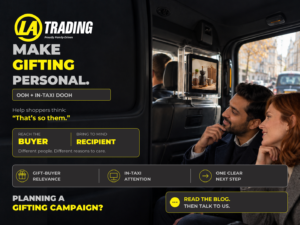
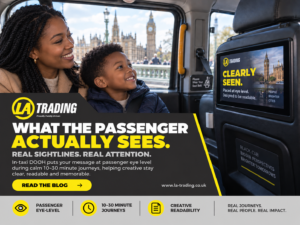
In-taxi DOOH gives brands a more focused pocket of attention during the journey.
That matters because the post-scroll consumer is not short of ads.
They are short of ads that arrive in a context where they can actually take them in.
Inside a taxi, the passenger is seated.
The screen is visible.
The journey has duration.
The message can repeat.
The creative can invite action.
The brand can become part of the ride rather than another interruption.
That is a very different media moment.
Real-world does not mean old-fashioned
There is a strange assumption that real-world media is less advanced than online media.
That is outdated thinking.
Modern DOOH is flexible, targeted, measurable, and creative.
Campaigns can be updated.
Messages can be localised.
Creative can change by time, place, audience, route, or campaign objective.
QR codes and NFC can bridge offline attention into online action.
Reporting can help brands understand performance beyond simple exposure.
That is why DOOH is so exciting.
It brings digital flexibility into the real world.
For brands used to fast campaign optimisation, that matters.
For OOH agencies building wider media strategies, it creates a natural bridge between public visibility and interactive engagement.
The best campaigns now feel less like ads and more like timing
The post-scroll consumer does not hate advertising.
They hate bad timing.
They hate being interrupted when they are trying to do something else.
They hate being followed around the internet by the same product they already bought.
They hate being shouted at by brands that clearly did not read the room.
A good DOOH campaign feels different because it respects context.
A restaurant advert during an evening taxi journey feels useful.
A hotel message on an airport route feels relevant.
An event promotion near a venue feels timely.
A finance or professional service campaign during business travel feels considered.
A retail offer near a shopping route feels actionable.
That is not just advertising.
That is timing.
And timing is becoming one of the most important parts of media planning in 2026.
Why brands should not abandon the feed, but should stop relying on it alone
Online media still has a huge role to play.
Search, social, video, display, retargeting, content, email, and e-commerce all matter.
But when everything happens online, brands risk becoming too easy to ignore.
The smartest campaigns are becoming more balanced.
They use digital for targeting, conversion, and follow-up.
They use OOH for fame, credibility, and scale.
They use DOOH for contextual engagement and real-world attention.
They connect the journey rather than forcing one channel to do everything.
That is how brands build stronger recall.
Not by shouting in one place.
By showing up properly across the moments that matter.
The emotional advantage of being seen in real life
There is something reassuring about seeing a brand outside your phone.
It makes the brand feel less temporary.
A screen ad can vanish with a swipe.
A real-world presence feels more deliberate.
That emotional difference is subtle, but it matters.
People are more likely to trust brands that feel present in their world.
Not just present in their feed.
When a brand appears during a real journey, it becomes attached to a real moment.
The passenger remembers where they were going.
What they were doing.
What they were thinking about.
Why the message felt relevant.
That is how memory starts to form.
The FOMO bit: attention is moving, literally
The brands that win in 2026 will not only be the ones with the biggest budgets.
They will be the ones that understand where attention is still available.
And a lot of that attention is not sitting neatly in a digital dashboard.
It is moving through cities.
It is in taxis.
It is in travel moments.
It is between meetings.
It is on the way to hotels, restaurants, airports, events, shops, and venues.
It is in those small windows of time where people are not fully distracted by everything else.
If your brand is not present there, someone else can be.
That is the opportunity.
Not to replace your wider OOH strategy.
To strengthen it with a DOOH layer that reaches people when they are more likely to actually notice.
Final thought
The post-scroll consumer is not unreachable.
They are just harder to impress.
They have seen enough ads to know when something is irrelevant. They have skipped enough content to know what they do not care about. They have trained themselves to move quickly past anything that feels like noise.
That is why real-world attention is becoming premium again.
OOH gives brands public presence.
In-taxi DOOH adds focused passenger attention.
Together, they help brands show up in a way that feels visible, credible, and better timed.
And in 2026, timing may be the difference between being seen and being remembered.
So yes, keep building strong digital campaigns.
But maybe give your customer’s thumb a break.
Put the message somewhere they cannot just scroll past.
Want to reach the post-scroll consumer in a real-world, high-attention environment? Speak to
LA Trading about in-taxi DOOH campaigns that help your brand move from visibility to meaningful engagement.