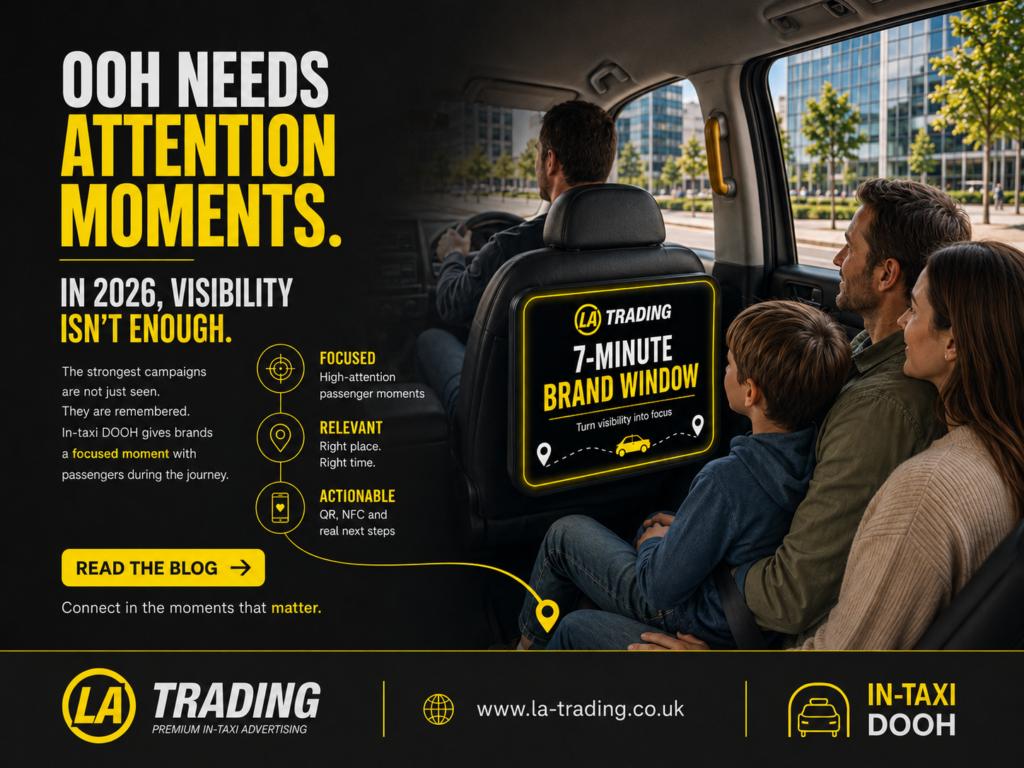
What is the 7-minute brand window?
The 7-minute brand window is the short but powerful period where someone is not rushing past your message, skipping it, scrolling over it or being attacked by 14 tabs and a group chat called “Weekend Plans???”
It is the moment where a person has enough time to notice, process and emotionally register a brand message.
In traditional OOH, that moment might begin on a high street, roadside, transport route or event space. The campaign creates visibility. It builds the first spark. It puts the brand into the real world.
In-taxi DOOH then gives that spark somewhere to settle.
Inside a taxi, passengers are seated. They are between destinations. They have time. Their phone may be in their hand, yes, but they are not moving through an endless public space. They are in a contained environment where a screen can become part of the journey.
That does not replace OOH. It gives OOH a stronger attention layer.
The problem is not OOH. The problem is rushed attention.
OOH does a brilliant job at scale. It gives brands visibility in places where life actually happens. Streets, stations, city centres, airports, nightlife areas, shopping zones and business districts all carry cultural energy.
But human attention has changed.
People are moving faster. They are multitasking harder. They are consuming more content than ever while remembering less of it. So the challenge for marketers is not simply reaching people. It is giving them enough time to care.
This is why in-taxi DOOH works so well as a companion to wider OOH campaigns.
A billboard can create the big public moment.
A taxi screen can create the focused private moment.
Together, they move a campaign from “I saw that somewhere” to “I actually remember that brand.”
Why attention moments matter more in 2026
The brands winning in 2026 are not always the loudest. They are the ones that understand timing.
A restaurant advert shown to someone heading into town feels different from the same advert seen randomly online at 11:42pm while they are half-asleep.
A property campaign shown during a commute feels different from one buried between social videos.
A retail offer shown while someone is travelling near a shopping area has more context than one dropped into a crowded feed.
OOH gives the campaign public confidence. DOOH inside taxis gives it situational relevance. That combination is where modern brand memory is built.
The emotional side of dwell time
Marketers love metrics. Reach, impressions, scans, engagement rates, uplift, attribution. All useful. All important.
But there is another piece that is harder to measure and impossible to ignore: feeling.
When someone is in a taxi, they are often going somewhere that matters to them. A meeting. A date. A hotel. A night out. A viewing. An airport. A dinner. A hospital appointment. A train station. A university. A shopping trip.
There is emotion in movement.
That makes the journey a valuable brand environment. Not because passengers are trapped, but because they are present. They are already in a moment of transition, and transition is where decisions often happen.
What shall we eat?
Where shall we go next?
Which brand do I trust?
Should I scan that?
Should I book that?
Should I remember that name?
That is the space in-taxi DOOH occupies.
Why OOH brands should care
For OOH media owners, agencies and brands, in-taxi DOOH is not a threat to traditional formats. It is a way to stretch campaign value.
Think of it as the attention bridge.
Your OOH campaign creates reach and visibility.
Your in-taxi DOOH placement deepens the moment.
Your QR, NFC or landing page gives the audience a next step.
This is especially valuable for campaigns where awareness and action need to work together. Hospitality, property, retail, entertainment, education, tourism, recruitment, finance, events and app campaigns can all benefit from reaching people when they are moving with intent.
OOH makes the brand visible.
Taxi DOOH makes the brand available.
That difference matters.
The best campaigns do not shout. They arrive at the right time.
There is a temptation in advertising to keep making everything louder. Bigger headline. Faster animation. More urgency. More exclamation marks. More “limited time only” energy until the campaign sounds like it has had six coffees and no lunch.
But attention in 2026 is not won by shouting alone.
It is won by showing up in the right environment with something worth noticing.
The taxi screen gives brands a rare media setting: personal, moving, local, measurable and connected to real journeys. It lets advertisers speak to people in a way that feels less like interruption and more like relevance.
How to use the 7-minute brand window
A smart in-taxi DOOH campaign should not just copy and paste a billboard creative. The setting is different, so the creative should be too.
Use the taxi moment to:
- Tell a shorter, sharper version of the campaign story
- Add a local offer or location-based message
- Invite a scan, tap or action
- Build recall with simple branding
- Connect the journey to the destination
- Support the wider OOH campaign with a more focused message
The goal is not to overload passengers. It is to make the next step feel obvious.
Final thought
OOH is still brilliant at making brands famous in the real world.
But in 2026, fame needs focus.
That is why OOH advertising attention moments are becoming so important. The strongest campaigns are not just seen at speed. They are remembered during the journey.
And if your campaign is already out there on the street, on the roadside or across the city, the next question is simple:
Where does your audience go after they have seen it?
Quite possibly, they get in a taxi.
And that might be the best 7 minutes your brand gets all day.
Want to turn your OOH campaign into a focused passenger moment? Speak to LA Trading about adding in-taxi DOOH to your next media plan.