OOH creates the first moment. DOOH can create the second.
OOH is often the first big public moment for a campaign.
It creates awareness.
It gives the brand physical presence.
It gets the message into the streets, roads, stations, venues, and cities where people actually move.
But people do not always act the first time they see something.
- They notice.
- They half-remember.
- They carry on.
- They see it again.
- Then, if the timing feels
- right, they respond.
That second moment matters.
And that is where in-taxi DOOH becomes interesting.
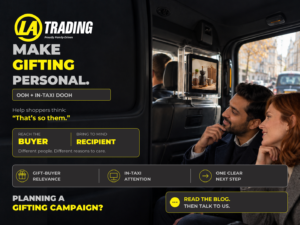
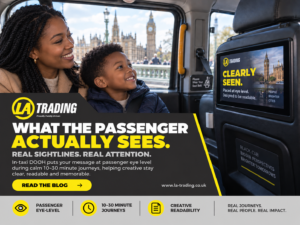
A passenger gets into a taxi after already being exposed to the wider campaign. They sit down. The door closes. The journey begins. Suddenly, the brand has a quieter, more focused environment to reappear.
Not shouting.
Not replacing OOH.
Simply continuing the story.
That is the second life of an OOH campaign.
Why campaign extension matters more in 2026
Modern audiences are busy, distracted, and very good at filtering out noise.
They are not ignoring brands because they dislike advertising. They are ignoring advertising because there is too much of it.
Feeds are crowded.
Screens are crowded.
Roads are crowded.
Inbox tabs are basically emotional damage.
That does not mean OOH has lost value. Far from it.
OOH still gives brands something digital-only media often struggles to deliver: public credibility.
But public visibility becomes more powerful when it is supported by follow-up moments.
A campaign that appears once may be noticed.
A campaign that appears again in a relevant, high-attention environment has a better chance of being remembered.
That is the shift.
In 2026, brands should not just plan media locations. They should plan campaign movement.
Where does the message start?
Where does it travel?
Where does it get reinforced?
Where does the audience have time to absorb it?
Where can action happen?
A taxi journey gives brands a natural answer.
The taxi is not just transport. It is a media bridge.
A taxi sits in a useful space between public movement and personal attention.
People are out in the real world, but they are also seated inside a contained environment.
They are moving through a city, but they are not physically navigating every step.
They have a destination, but they also have time.
That makes the taxi journey a powerful media bridge between broad OOH exposure and more focused engagement.
The audience has already left the street, venue, office, hotel, restaurant, station, or airport.
But they have not disappeared from the campaign opportunity.
They are still moving.
And if your campaign can move with them, you have extended the value of your original OOH investment.
OOH and in-taxi DOOH are stronger together
This is not about saying one format is better and the other is old news.
That would be lazy.
OOH and in-taxi DOOH do different jobs.
OOH gives your campaign scale and public confidence.
In-taxi DOOH gives your campaign extra attention time and a more contained environment.
OOH helps people notice.
In-taxi DOOH helps people sit with the message.
OOH builds the big moment.
In-taxi DOOH helps the message travel into the next one.
That is why the two formats complement each other so well.
For brands already investing in OOH, in-taxi digital advertising can act as a powerful supporting layer that keeps the campaign visible after the audience has moved on from the first touchpoint.
What a second-life campaign could look like
A strong OOH campaign might launch across city centres, roadside media, transport environments, or key retail locations.
Then in-taxi DOOH can support it with:
- A shorter version of the main campaign message
- A QR code for action
- A location-specific offer
- A campaign reminder near key destinations
- A product launch message
- A time-sensitive promotion
- A brand recall creative
- A “seen it outside, now act inside” style follow-up
The key is not to overload the screen.
Nobody gets into a taxi hoping to read the brand guidelines.
The second-life message should be simple, useful, and easy to remember.
Think:
“Book now.”
“Scan for offer.”
“Find your nearest store.”
“Discover the campaign.”
“Limited launch available today.”
“Your journey just got rewarded.”
The role of the taxi screen is not to repeat everything.
It is to give the campaign a sharper next step.
Why FOMO belongs in the media plan
Here is the slightly uncomfortable bit.
If your campaign stops after the first public exposure, another brand can own the next moment.
You may have done the hard work of building awareness, only for someone else to show up closer to the decision.
That is not ideal.
It is a bit like paying for the starter, cooking the main course, setting the table, then letting another brand turn up with dessert and take the compliments.
In 2026, brands cannot afford to think of visibility as a one-stop job.
The strongest campaigns create continuity.
They appear in the real world.
They follow the audience naturally.
They reinforce the message.
They give people a reason to act.
That is where OOH campaign extension becomes less of a “nice extra” and more of a smart planning decision.
The human bit: people remember journeys
People often attach memories to movement.
The taxi to the airport before a holiday.
The ride home after a night out.
The journey to a meeting.
The cab across town before a big event.
The short trip from station to hotel.
The drive to a shopping district.
These are not dead moments.
They are transition moments.
People are thinking, planning, anticipating, deciding.
A brand that appears during those moments can feel timely rather than forced.
That is what makes in-taxi DOOH feel different.
It does not interrupt the journey.
It becomes part of it.
Final thought
OOH still gives brands one of the most powerful ways to be seen in the real world.
But in 2026, being seen is only the start.
The bigger opportunity is what happens next.
Can your campaign follow the audience?
Can it reinforce the message?
Can it become more memorable?
Can it create a simple action point?
Can it turn public visibility into focused engagement?
That is the second life of an OOH campaign.
And for brands that already invest in real-world media, in-taxi DOOH is not a replacement. It is a clever continuation.
So next time your campaign goes live and everyone proudly takes that photo of the billboard, enjoy the moment.
Then ask the better question.
Where does this campaign go after the audience gets moving?
Want to give your next OOH campaign a second life? Speak to LA Trading about adding an in-taxi DOOH layer that keeps your brand visible, memorable, and moving.