Why retargeting needs a reset
Retargeting is not a bad idea. In theory, it is actually very sensible.
Someone shows interest. A brand follows up. The message becomes more relevant. The customer journey continues.
The problem is how often retargeting feels.
Online retargeting can be persistent, repetitive and sometimes slightly unsettling. People are increasingly aware of how they are tracked, where their data goes and why the same advert keeps appearing after they have already decided they do not want the thing.
This is where brands need a better balance.
They still need ways to reconnect. They still need performance. They still need measurable engagement. But they also need advertising that feels less invasive and more respectful.
OOH retargeting with DOOH offers that balance.
It brings the reconnecting power of retargeting into the real world, where the audience is not being followed one-to-one across private browsing spaces. Instead, the brand creates useful, contextual opportunities for people to take the next step when they are already in a relevant environment.
That is a much better feeling.
OOH builds trust before the follow-up
OOH has always been powerful because it is public, visible and part of everyday life.
A poster, a roadside format, a transport placement or a city-centre campaign does not feel hidden. It does not feel sneaky. It simply exists in the world, helping brands build familiarity, recognition and trust.
That matters.
When people see a brand in a real-world environment, it can feel more established and more credible. OOH gives campaigns presence. It puts the brand into shared spaces where people live, work, travel, shop and socialise.
But awareness is only the start.
Modern campaigns need to help people move from seeing to doing. That might mean scanning a QR code, tapping NFC, visiting a landing page, downloading an app, booking a service, claiming an offer or simply learning more.
This is where DOOH can support OOH beautifully.
OOH builds the stage. DOOH gives the audience a way to step closer.
DOOH turns attention into action
Digital out-of-home is not just about screens. It is about flexibility, timing and interaction.
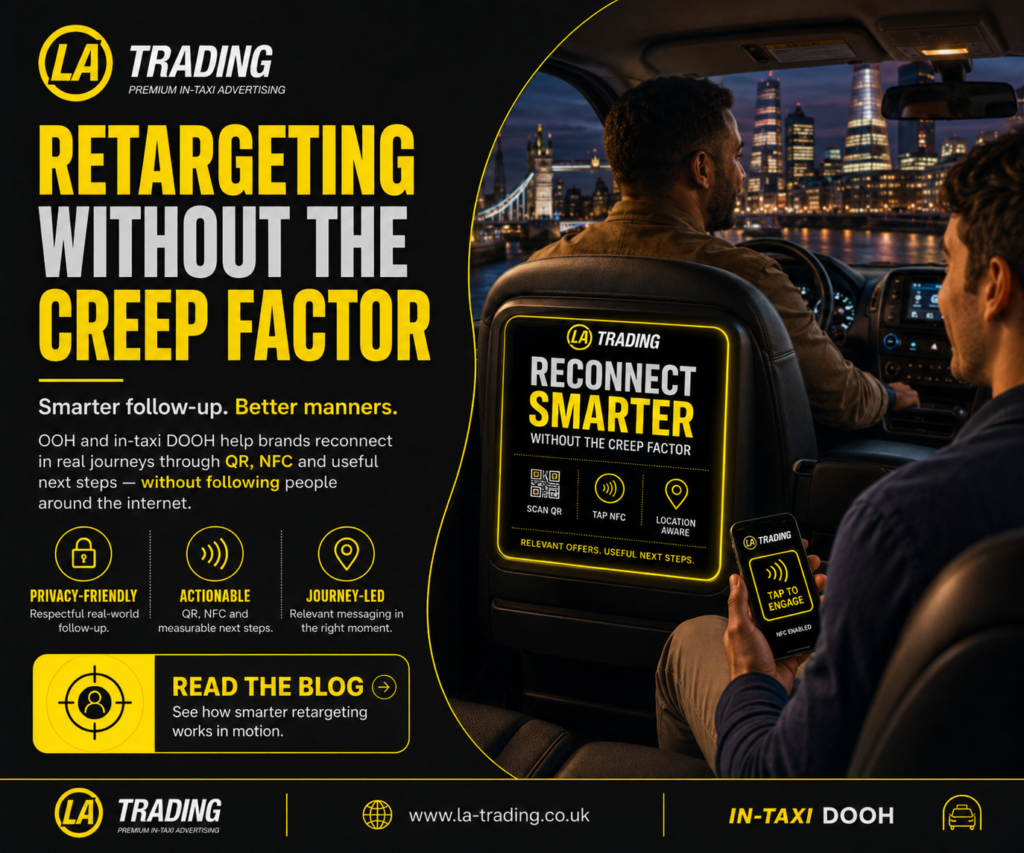
In-taxi DOOH gives brands a more focused environment where passengers are seated, present and often open to useful information. They are not rushing past a message. They are spending time inside a journey.
That creates a valuable opportunity.
A passenger might have already seen a wider OOH campaign in the city. Then, inside the taxi, the brand can appear again with a more actionable message.
Not in a creepy way. Not in a “we know what you clicked last night” way.
In a simple, useful way.
For example:
A restaurant campaign seen in the city can become a booking prompt inside a taxi.
A retail campaign can become a store visit message when passengers are near a shopping area.
An event campaign can become a ticket reminder during evening journeys.
A property campaign can direct passengers to available developments or viewing appointments.
A travel campaign can encourage app downloads, upgrades or destination-based offers.
A local service campaign can give passengers a quick way to enquire while they are nearby.
That is the strength of OOH retargeting with DOOH. It connects the broad visibility of OOH with a more direct, measurable next step.
QR and NFC make the journey interactive
For years, outdoor advertising was sometimes treated as a brand awareness channel only.
That was never the full story, but it was harder to prove what happened next.
Now, DOOH formats can support clearer action.
QR codes and NFC give passengers a quick route from attention to engagement. Someone sees the message, understands the offer and can take action there and then.
Inside a taxi, this is especially useful because the environment gives people time.
They are not walking past. They are not driving. They are not trying to cross a road while reading a headline. They are seated in a journey, often with a few minutes where scanning, tapping or visiting a landing page feels natural.
This does not mean every campaign needs a loud “BUY NOW” message.
In fact, the best campaigns often feel calmer than that.
A simple prompt can work harder when the context is right:
“Scan for nearby availability.”
“Tap to explore the offer.”
“Plan your visit.”
“Download before you arrive.”
“Book your table.”
“See what is near you.”
The CTA feels useful because it matches the moment.
The taxi journey is a natural retargeting environment
A taxi journey has something many advertising environments do not have: intent.
Passengers are going somewhere. They have a reason for moving. That reason gives brands context.
They may be heading to a hotel, airport, restaurant, meeting, shopping district, university, event, station, hospital, theatre, viewing, office or night out.
That movement matters.
It means the audience is not just a demographic on a spreadsheet. They are in a real journey with a location, time, purpose and mindset.
OOH retargeting with DOOH can use that environment to create messages that feel connected to what the passenger may be doing next.
That could mean location-led creative. It could mean time-of-day messaging. It could mean campaign variations that change between morning, afternoon, evening and weekend journeys. It could mean different calls to action depending on the route, destination area or campaign objective.
This is not about overcomplicating outdoor media.
It is about making it more fluent.
One campaign idea can have several useful expressions, each one shaped by the moment.
Privacy-friendly does not mean performance-light
Some brands worry that more respectful advertising means weaker performance.
It does not.
Respectful advertising can still be sharp, measurable and commercially effective. In fact, it often performs better because people are more likely to engage when the message feels relevant rather than forced.
The key is to create action points without making people feel watched.
In-taxi DOOH can support this by giving brands measurable engagement routes through QR, NFC, campaign URLs and dedicated landing pages. This helps advertisers understand interest, interaction and response without relying on the kind of intrusive tracking that makes people uncomfortable.
It is performance marketing with better manners.
That is why OOH retargeting with DOOH is so interesting for brands, agencies and media planners. It supports the next stage of the customer journey while keeping the experience grounded in the real world.
The audience chooses to engage.
That choice matters.
DOOH supports OOH without replacing it
OOH and DOOH should not be treated as rivals.
They work best when they support each other.
Traditional OOH gives campaigns scale, visibility and public presence. It helps brands become known and recognised. DOOH adds flexibility, movement, timing and interactivity. Together, they create a stronger journey from awareness to action.
Think of OOH as the first big moment.
Then think of in-taxi DOOH as the follow-up that happens in a more focused environment.
A person may see the brand while moving through the city, then encounter a more interactive version inside the taxi. The message is familiar, but now it has a clearer next step.
That is not repetition for the sake of it.
That is sequence.
And good sequencing is what makes campaigns feel smarter.
What brands can use OOH retargeting with DOOH for
OOH retargeting with DOOH can support a wide range of campaign goals.
For brand awareness campaigns, it gives audiences another point of contact in a high-attention environment.
For lead generation campaigns, it creates a clear route to enquiry.
For app campaigns, it gives passengers a simple way to download while they have time.
For retail and hospitality campaigns, it can direct people to nearby locations, offers or bookings.
For events and entertainment, it can speak to passengers when they are already in leisure mode.
For property, recruitment, travel, education and local services, it can connect messaging to real movement, real places and real intent.
The strongest campaigns are not always the loudest.
They are the ones that understand where the audience is, what they may need and what action makes sense in that moment.
Why this matters in 2026
Audiences are becoming more selective.
They ignore generic messages quickly. They scroll past weak creative. They block, skip, mute and mentally filter out anything that feels irrelevant.
But people still notice advertising that belongs in the moment.
They notice useful messages. They notice strong creative. They notice brands that show up in the right place with something that makes sense.
That is why OOH retargeting with DOOH is so valuable.
It gives brands a way to keep the conversation going without making the audience feel chased. It adds action to awareness. It gives OOH campaigns a more measurable next step. And it helps DOOH become more than a screen. It becomes a bridge between real-world visibility and real-world response.
Final thought
Retargeting does not need to feel creepy.
It does not need to follow people around the internet until they give in out of exhaustion.
It can be smarter than that.
OOH retargeting with DOOH gives brands a more respectful way to reconnect with audiences. It uses real journeys, in-taxi screens, QR, NFC and location-led messaging to make advertising feel useful, timely and relevant.
OOH creates the public presence.
DOOH creates the interactive moment.
Together, they help brands move from being seen to being remembered, explored and acted on.
Want your OOH campaign to reconnect without the creep factor? Talk to LA Trading about in-taxi DOOH campaigns built for real journeys, real attention and smarter next steps.