Visibility is only the first step
OOH gives brands something digital channels often struggle to replicate: public presence.
When a campaign appears in busy streets, transport environments and city centres, it can make a brand feel part of everyday life. It is not waiting inside an app. It exists in the same physical world as the customer.
That visibility remains immensely valuable.
The UK OOH market generated record annual revenue of £1.44 billion in 2025, while digital formats continued to represent a major share of industry investment.
However, visibility and memory are not identical.
An audience can technically see an advert without processing much of it. Memory is more likely to form when the message has enough clarity, repetition and relevance to create a meaningful mental connection.
Why travel moments can be memorable
Journeys naturally divide the day into chapters.
There is the trip to work, the journey to a hotel, the taxi to dinner, the ride to an event and the late trip home when everyone suddenly becomes a philosopher.
These transitions carry emotional context.
A passenger may feel:
- Excited about where they are going
- Curious about an unfamiliar city
- Relieved to have finished work
- Focused before an important meeting
- Open to recommendations
- Ready to make plans
Advertising that matches the emotional or practical context of the journey has a better opportunity to feel useful.
A theatre advert on the way into a city centre means something different from the same advert appearing randomly during an unrelated online task.
The creative has entered the audience’s current world.
Memory is often built through association
People rarely remember advertising as an isolated file stored neatly in the brain.
They remember it through associations:
- The place they saw it
- What they were doing
- How it made them feel
- The phrase that stood out
- The image that made them laugh
- The offer that became relevant later
Journey-based DOOH gives advertisers several of these memory cues at once.
The passenger remembers the destination, the city, the conversation, the taxi ride and potentially the brand presented during that experience.
This does not mean every taxi advert becomes permanently engraved into human consciousness. That would make media planning suspiciously easy.
It means the environment can give the creative more opportunities to connect with an existing moment.
Familiarity without digital fatigue
Online frequency can be useful, but it can also become obvious.
When the same advert repeatedly follows someone across websites, it may feel less like brand familiarity and more like the product has learned their home address.
OOH and DOOH can build recognition in a less intrusive way because the message appears within shared real-world environments.
No personal profile needs to be displayed.
No browser history needs to be discussed.
The brand simply appears in a relevant place with a useful message.
That public, contextual presence can help brands stay familiar without making audiences feel individually pursued.
The creative ingredients of memorability
Brand memory rarely comes from adding more information.
It usually comes from making fewer things more distinctive.
For journey-based DOOH, this means prioritising:
One recognisable visual idea
Use an image, colour treatment or character that the audience can connect with the wider campaign.
One clear message
The passenger should not need to conduct a board meeting to understand the advert.
One emotional response
Humour, curiosity, appetite, excitement or reassurance can give the message a reason to stay.
One sensible action
A QR code, URL, offer or invitation can help interested passengers continue without making the advert feel like an instruction manual.
The goal is not to explain everything.
It is to create a strong enough impression that the brand remains recognisable when the customer encounters it again.
OOH and in-taxi DOOH can share memory signals
One of the most useful ways to strengthen recall is to carry distinctive campaign elements across different formats.
For example, a brand could retain:
- The same headline structure
- A recognisable image
- The same campaign character
- A specific colour combination
- A memorable phrase
- A continuing story
The large-format OOH creative creates initial fame.
The internal taxi screen reinforces the same identity in a closer, more focused environment.
This partnership allows the formats to support each other without asking either one to perform every role.
Classic OOH can remain bold, simple and visually commanding.
In-taxi DOOH can add another layer of meaning.
The passenger should feel included
Many adverts speak at audiences.
More memorable campaigns make people feel involved.
The screen can ask a playful question, acknowledge the journey or present a situation the passenger recognises.
Examples might include:
- “Still deciding where to eat?”
- “Your weekend plans have entered the chat.”
- “You are closer than you think.”
- “Meeting finished. Now for the interesting part.”
- “New city? Start here.”
These lines work because they connect the advert to a human moment.
They do not need to know who the passenger is.
They simply understand what travelling often feels like.
Measure more than immediate response
QR scans and website visits can provide useful indications of action, but brand memory also contributes value beyond an instant click.
A passenger might see the advert today and search for the business later.
They may mention it to someone else.
They may recognise the brand during a future purchase decision.
They may visit a physical location without remembering exactly which part of the campaign influenced them.
This is one reason the OOH industry continues developing more consistent approaches to audience and effectiveness measurement. Route provides the recognised audience-measurement framework for OOH campaigns across Great Britain, while the IAB has highlighted the need for clearer and more aligned DOOH measurement practices.
Good campaign evaluation should therefore consider both immediate interaction and wider brand impact.
Make the journey part of the idea
The strongest journey-based creative does not simply occupy the screen.
It understands why the passenger is there.
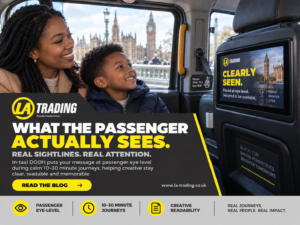
A taxi journey is a temporary space between one experience and the next. Brands that use that pause intelligently can create recognition without shouting and relevance without intruding.
Because the aim is not for someone to stare at an advert for the entire journey.
That would be impressive, but slightly concerning.
The aim is for the brand to leave a clear, positive impression that travels beyond the taxi.
Want your next campaign to be remembered after the passenger arrives? Contact LA Trading to explore how journey-based DOOH can