OOH Creates Recognition. DOOH Can Extend It.
OOH is incredibly good at creating scale.
A strong roadside campaign, city-centre digital screen, rail placement or transport execution can make a brand feel visible, established and familiar.
That matters.
But the customer journey does not stop when someone walks past the poster.
They keep moving.
They get on trains.
They go shopping.
They head to restaurants.
They take taxis.
And that creates another opportunity.
Passenger DOOH can continue the campaign without trying to replace the original OOH execution.
Think of it as the next chapter, not a competing channel.
A large-format campaign might create the recognition.
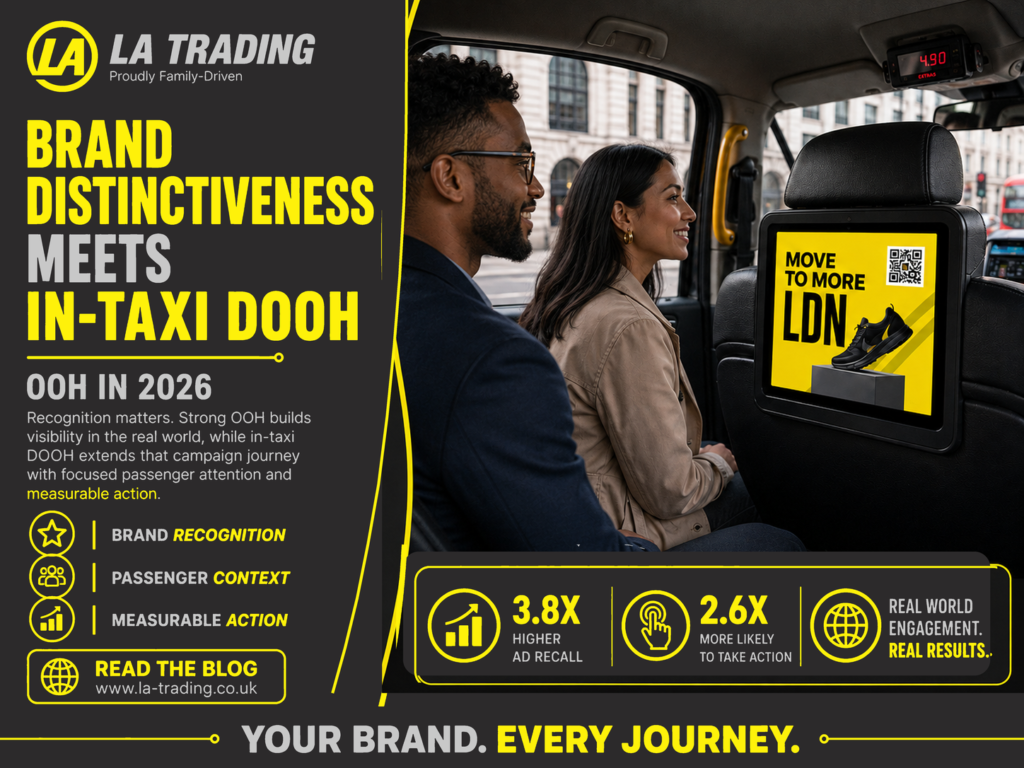
An in-taxi screen can then reinforce the brand, show a product, introduce a video, support a launch or provide a useful next action.
Same campaign.
Different environment.
Different role.
The Clever Part Is Not More Screens
This is where advertisers can get distracted.
More screens do not automatically create a better campaign.
More relevant moments might.
The best OOH strategies increasingly use different environments for different jobs.
A major digital site might deliver spectacle.
Rail can create commuter frequency.
Retail media can support purchase intent.
Passenger DOOH can create a more contained moment during the journey.
None of those formats needs to “beat” the others.
The value comes from how they work together.
That is especially important for OOH businesses and agencies because it means a wider toolkit for solving client briefs rather than forcing every campaign into the same format.
Distinctive Brands Travel Better
The more places a campaign appears, the more important consistency becomes.
Not sameness.
Consistency.
A campaign can change its message without changing its identity.
The same colours.
The same typography.
The same tone.
The same visual cues.
The same product world.
But perhaps a different message depending on where someone is.
Imagine a hospitality brand running a bold city-centre OOH campaign.
Later, a passenger sees the same brand inside a taxi on the way into town.
Instead of repeating the same poster, the creative could say:
Dinner plans? You are seven minutes away.
That feels connected.
It feels relevant.
Most importantly, it still feels like the same brand.
That is where DOOH becomes much more interesting than simply digitising a poster.
Movement Creates Context
One reason transit and passenger DOOH deserve more attention is that movement itself tells us something.
A person travelling to an airport is in a different mindset from someone heading home after work.
Someone travelling to dinner is thinking differently from somebody travelling to a business meeting.
The media environment changes with the journey.
That gives advertisers a chance to make creative more useful without becoming invasive.
You do not need to know everything about someone.
Sometimes the context is enough.
Airport journey.
Retail trip.
Night-time economy.
Business travel.
Event journey.
Hotel transfer.
The opportunity is to match the creative to the moment while keeping the brand unmistakably recognisable.
This Is Where OOH Gets Stronger, Not Weaker
Passenger DOOH should not be positioned as a replacement for established OOH.
That misses the point.
Large-format OOH can create fame in a way smaller environments simply cannot.
A spectacular campaign can dominate a location and make a launch feel culturally important.
Passenger screens offer something different.
They can give the campaign another opportunity to speak once the customer is already moving through the world.
That makes the overall OOH ecosystem stronger.
More formats.
More creative options.
More ways to answer a client brief.
The FOMO Is Strategic
Nobody needs another article screaming:
“YOU MUST BUY DOOH IMMEDIATELY OR YOUR BRAND WILL DISAPPEAR BY THURSDAY.”
That is not useful.
The more interesting FOMO is this:
How many valuable customer moments are happening after your main OOH exposure with no continuation of the campaign?
Someone sees your brand.
They recognise it.
Then they travel somewhere.
Could the next exposure build on that recognition?
Could it give them something useful?
Could it move them from awareness into interest?
That is the opportunity.
One Question Worth Asking Before Your Next Campaign
When you look at your next OOH campaign, ask:
If someone sees this in the city and then sees us again 20 minutes later during their journey, what should the second message do?
If you have a good answer, you may already have the foundations of a stronger OOH and DOOH strategy.
And if you do not?
That is exactly the kind of conversation worth having.
At LA Trading, our in-taxi DOOH network is designed to sit alongside wider OOH activity and create another meaningful passenger touchpoint during the journey.
So if you are planning a campaign and want to explore where passenger DOOH could genuinely add value, send us the brief.
Not because every campaign needs another screen.
Because some campaigns deserve another memorable moment.