OOH has never needed to become online advertising
Nor should it.
One of OOH’s greatest strengths remains its physical presence.
A billboard does not need somebody to accept cookies before it becomes visible.
A large-format campaign can build fame, recognition and cultural presence brilliantly.
DOOH simply gives that environment another layer:
greater flexibility, better reporting and more responsive delivery.
That evolution is accelerating. IAB UK’s 2026 DOOH forecast says digital accounted for 67% of UK OOH advertising spend in 2025 and expects DOOH to reach 76% by 2031, alongside continued development in measurement and programmatic buying.
So naturally, advertisers are asking more questions about what happened after a campaign went live.
They should.
“It was on the screens” is no longer enough
Imagine spending serious money on a campaign and receiving this report:
Campaign completed successfully. Looked lovely. Everyone very pleased.
Useful?
Emotionally reassuring, perhaps.
Commercially?
Not so much.
Modern advertisers increasingly expect to understand:
- where media ran
- when it ran
- how many plays were delivered
- whether those plays completed
- how campaign delivery progressed
- what creative was used
- what happened across different screens or locations
That does not mean every metric should suddenly be presented as an impression.
Quite the opposite.
A play is a play.
An audience estimate is an audience estimate.
A QR scan is an interaction.
Keeping those things separate makes campaign reporting more believable, not less impressive.
This matters particularly for newer DOOH environments
When advertisers know a media environment already, buying feels easier.
They understand roadside.
They understand rail.
They understand airports.
They understand shopping centres.
Passenger DOOH inside taxis is still newer for many buyers.
That means education and reporting matter even more.
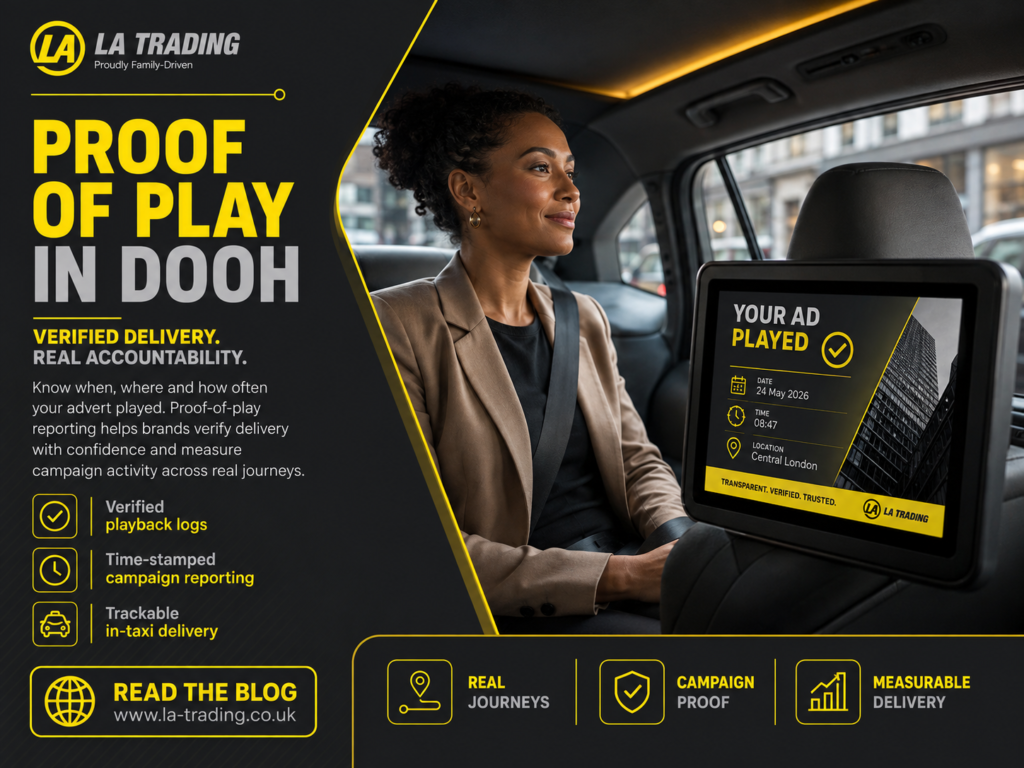
At LA Trading, our screens sit inside taxis during real passenger journeys.
For the advertiser, the useful question should not simply be:
“How many taxis have screens?”
It should also be:
“What did my campaign actually deliver across those screens?”
That is a healthier commercial conversation.
Proof builds confidence before the next campaign
Campaign reporting should not just close one booking.
It should improve the next one.
Imagine learning that:
- certain creative performed particularly well around a specific campaign period
- one city became especially relevant to the next phase
- a particular message deserves extending
- a QR-led concept should be developed further
- another creative needs simplifying
Now the report becomes useful marketing intelligence.
That is where DOOH measurement starts becoming genuinely interesting.
Not because someone has built a dashboard with enough graphs to operate a small airport.
Because better evidence creates better decisions.
The smartest advertisers will ask better questions
Instead of:
“How many impressions can you give me?”
Try:
“How will you show me what was delivered?”
Instead of:
“Can we have reporting?”
Try:
“What exactly does the report measure?”
And instead of assuming every number means the same thing:
ask what each metric actually represents.
It sounds obvious.
Marketing occasionally benefits from obvious.
Proof should strengthen the wider OOH plan
None of this reduces the importance of traditional OOH measurement or planning.
It strengthens the overall picture.
Large-format OOH can deliver scale.
Premium DOOH can provide contextual flexibility.
Transit can create movement and repeated exposure.
Passenger DOOH can add another journey-based touchpoint.
And transparent delivery data helps advertisers understand how each element contributed to the plan.
Modern OOH does not need every format to behave identically.
It needs every format to clearly explain the value it delivered.
Final thought: beautiful campaign, lovely. Where’s the report?
Nobody wants advertising to become an accounting exercise.
Creativity still matters.
Location matters.
Timing matters.
Ideas matter.
But once the champagne emoji has been posted on LinkedIn and everybody has congratulated the campaign team…
someone should probably check what actually ran.
That is why Proof of Play in DOOH Advertising deserves more attention in 2026.
Because transparency does not make creative media less exciting.
It makes it easier to buy again.
Want to see what measurable in-taxi DOOH delivery actually looks like? Ask LA Trading for a campaign example or sample delivery report — and we’ll show you the media, the passenger environment and the numbers behind it.