Cities Are Becoming Living Media Plans
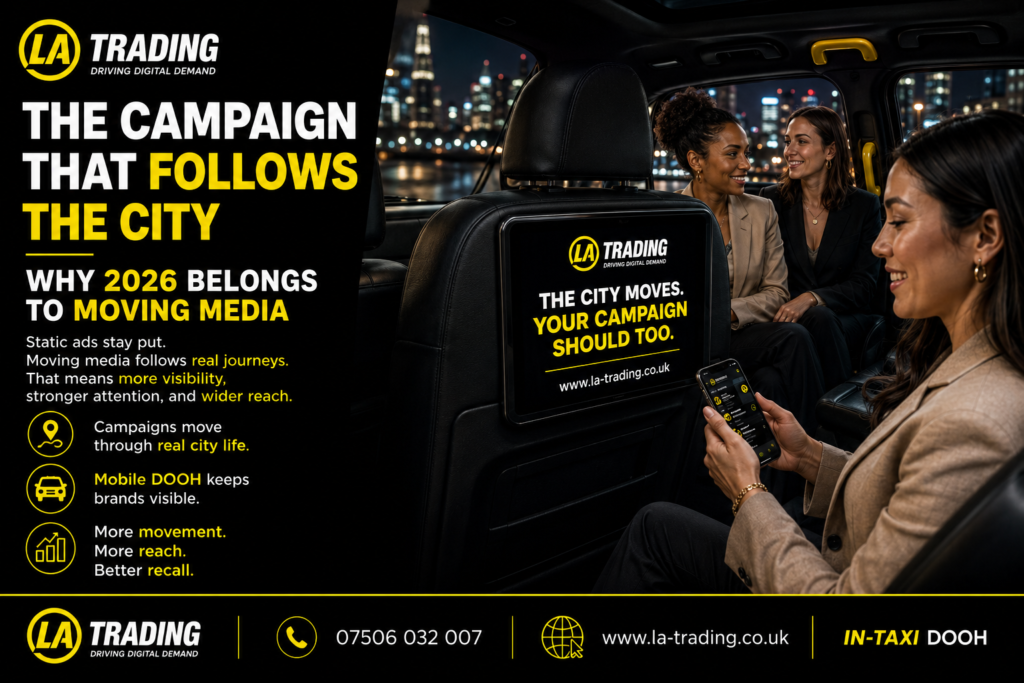
In 2026, the smartest brands are thinking about cities less like maps and more like behaviour patterns.
A city is not just a postcode.
It is morning commutes, lunch breaks, airport runs, football fixtures, late-night journeys, student areas, office districts, tourist routes, and weekend retail moments.
That is why movement matters.
A campaign that appears only in one location can be powerful. But a campaign that moves through the city can show up across multiple real-life contexts.
This is where taxi DOOH becomes particularly useful.
LA Trading’s location content describes a network approach built around national coverage, hyper-local targeting, and city tiers, with coverage across major UK cities and different screen volumes depending on location.
For marketers, that opens up a fresh planning thought:
Do not just buy the place.
Buy the journey.
The Journey Is Where the Mood Changes
A person walking past a billboard at 8:43am is not the same person sitting in a taxi at 6:17pm.
Same human.
Completely different mindset.
Morning: coffee, inbox, survival.
Evening: dinner, plans, decisions, maybe mild regret over agreeing to “just one drink.”
The journey changes the emotional state. And emotional state changes how people receive advertising.
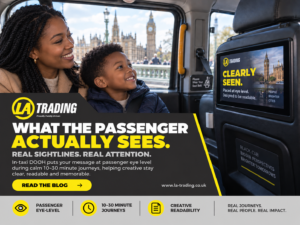
In-taxi screens reach people during these transitional windows. They are between places, between decisions, between one part of the day and the next.
That is valuable because brands do not only need visibility. They need receptivity.
A message seen during a calm passenger journey can land differently from a message seen while someone is rushing through a crowded street.
Moving Media Helps Brands Stay Contextual
One of the strongest opportunities in 2026 is contextual creative.
Not creepy.
Not over-personalised.
Just relevant.
Taxi DOOH allows advertisers to think about:
Time of day
City or region
Local events
Retail zones
Hospitality areas
Airport journeys
Night-time economy
Tourism and visitor movement
Business travel and commuter routes
This matters because context makes creative feel less generic.
A restaurant brand can promote evening bookings as people travel into town.
A hotel can speak to visitors already moving through a city.
A retailer can drive footfall near shopping districts.
A national brand can reinforce a wider campaign through localised messaging.
LA Trading positions geo-targeting as a way for brands to reach the right audience in the right place at the right moment, with route and time-of-day data helping campaigns feel more precise and personal.
That is exactly where moving media earns its place in the 2026 marketing mix.
Why OOH Agencies Should Care
OOH agencies already understand the value of location better than almost anyone.
They know that a campaign is not just about “space.” It is about audience movement, visibility, environment, timing, and repetition.
Taxi DOOH gives agencies another layer to plan with.
It can support:
Brand launches
Retail openings
Event activations
Tourism campaigns
Hospitality promotions
Property marketing
University and student campaigns
Entertainment and nightlife campaigns
Financial, legal, and professional services campaigns
And because it sits inside the passenger journey, it can add measurable engagement through QR codes, NFC, and digital prompts. LA Trading’s platform highlights QR, NFC, geo-targeted prompts, and reporting around impressions, scans, and engagement.
That is useful for agencies who want to keep the strength of OOH while giving clients more measurable digital interaction.
The Power of “Useful Visibility”
In 2026, visibility alone is not enough. People see thousands of things. The goal is to be visible at a moment when the message can actually be useful.
A gym advert on a taxi screen during a morning commute.
A restaurant offer on the way into town.
A theatre ad before an evening out.
A hotel campaign during airport travel.
A recruitment ad during weekday business journeys.
This is not just exposure.
It is useful exposure.
And useful exposure is far more likely to be remembered.
Moving Media Makes Campaigns Feel Alive
There is also something emotional about seeing a brand in motion.
A moving campaign feels active. Present. Current.
It gives the impression that the brand is part of what is happening now, not just sitting politely in the background hoping someone notices.
Taxi advertising also carries a subtle social proof effect. When people see a brand in a real-world environment, especially in a trusted transport setting, it can feel more established. More tangible. More “real.”
That is one reason physical-world advertising remains so important even as digital channels continue to evolve.
A Quick Reality Check
No, taxi DOOH will not make bad creative good.
A dull ad is still a dull ad, even if it travels through Birmingham wearing a nice screen.
But strong creative in the right journey environment?
That is where things get interesting.
In-taxi DOOH gives advertisers enough time to tell a slightly richer story than a blink-and-miss-it message. It can include a clear offer, a QR code, a location prompt, or a campaign extension that gives the viewer something to do next.
The taxi becomes more than a vehicle.
It becomes a moving media moment.
Final Thought
The city is already moving.
Customers are moving.
Attention is moving.
Decisions are moving.
The brands that succeed in 2026 will not only ask where people are. They will ask where people are going, what they are thinking about, and what message makes sense in that moment.
Traditional OOH gives campaigns an incredible public foundation.
Taxi DOOH gives that campaign movement, context, and closeness.
And if your brand can travel with the city without getting in anyone’s way, that is not just advertising.
That is momentum.
Planning a city campaign, event push, local launch, or national OOH extension? LA Trading helps brands move through real passenger journeys with in-taxi DOOH that complements wider media plans and keeps your message travelling…