The Problem With Action in Traditional Awareness Campaigns
The issue is not that people do not care.
It is that they are busy.
They see a campaign while walking, driving, commuting, shopping, or heading somewhere. The creative may land, but the moment to act disappears quickly.
Even if someone likes the message, they may not have time to:
Search the brand
Visit the website
Scan a code
Remember the offer
Take the next step
This is where a second, calmer environment helps.
Inside a taxi, the passenger has a little more time. The brand is directly in front of them. The journey creates a natural pause.
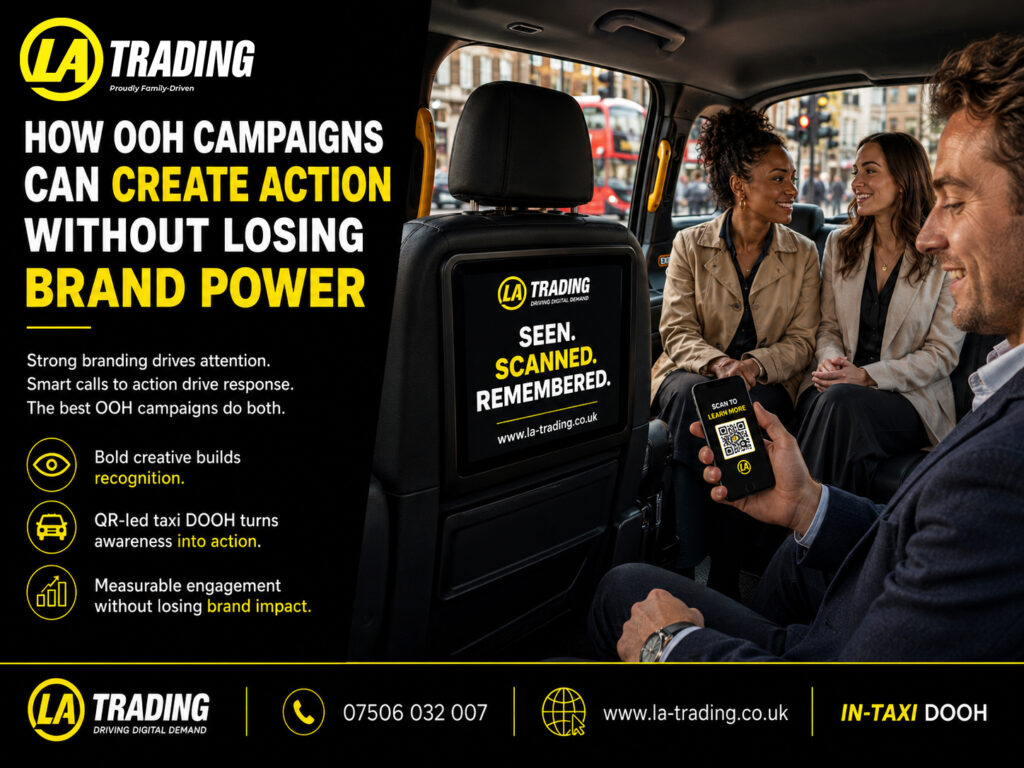
LA Trading describes taxi journeys as 10–30 minute environments where people can relax, disconnect, and engage with in-taxi screens, turning that travel time into brand experience.
That makes the jump from awareness to action feel far more realistic.
Why “Seen to Scanned” Matters in 2026
Marketers are under pressure from both sides.
Brand teams need campaigns that feel premium, memorable, and creatively strong.
Performance teams want evidence. Clicks. Scans. Leads. Store visits. Attribution. Something measurable enough to avoid the dreaded phrase: “Nice campaign, but what did it do?”
Taxi DOOH sits neatly between those needs.
It can support brand-building because it lives in a real-world environment.
It can support action because screens can include QR codes, NFC prompts, offers, store finders, booking links, and campaign landing pages.
LA Trading’s website highlights interactive engagement through QR codes, NFC, geo-targeted prompts, store finders, and digital experiences, helping turn passenger attention into measurable action.
That means the campaign does not have to choose between looking good and doing something.
It can do both.
The Best QR Codes Do Not Feel Like Homework
Let’s be honest. Some QR codes are tragic.
Tiny.
Hidden.
Unexplained.
Placed like someone remembered them six minutes before print deadline.
A good QR code needs a reason to exist.
In taxi DOOH, the reason can be clear because the passenger has time to understand the offer.
For example:
“Scan for today’s city offer.”
“Find your nearest store.”
“Book your table before you arrive.”
“Claim airport transfer discount.”
“Download the guide.”
“Join the launch list.”
“View available appointments.”
“Get the full campaign experience.”
The CTA should feel useful, not needy.
That is the difference between “Please scan because the marketing team asked” and “This is actually worth opening.”
In-Taxi DOOH Is Not Just a Screen. It Is a Decision Window.
The passenger journey creates a rare media condition: a person who is present, seated, and often between decisions.
They may be deciding where to eat.
Where to shop.
Which hotel to book next time.
Which event to attend.
Which service to trust.
Which brand to remember.
This is why in-taxi advertising can work so well for industries where timing matters:
Hospitality
Retail
Travel
Property
Education
Healthcare and wellness
Events
Local services
Professional services
Entertainment
Tourism
The brand does not have to interrupt. It simply appears during a decision window.
How OOH and Taxi DOOH Can Work Together
A strong “seen to scanned” campaign might look like this:
Large-format OOH creates public awareness across the city.
Transport or roadside media builds recognition.
In-taxi DOOH gives passengers the interactive version.
QR or NFC connects them to a booking page, offer, store finder, or landing page.
Reporting helps the advertiser understand engagement.
That is a clean brand journey.
Public awareness → passenger attention → measurable action.
No channel is undermined. Each format has a role.
Traditional OOH creates the broad signal.
Taxi DOOH gives the audience a chance to respond.
Why This Appeals to OOH Brands and Media Buyers
OOH has always been a powerful brand medium.
But in 2026, clients increasingly want campaign architecture that includes both fame and action. That does not mean turning every OOH placement into a performance ad. It means building a media plan where action is available when the audience is ready.
Taxi DOOH can help OOH campaigns offer a stronger conversion layer without losing the quality and credibility of real-world media.
For media buyers, this gives a useful planning advantage:
The campaign can still feel premium.
The audience can still experience it naturally.
The client can still see engagement signals.
The creative can still tell a brand story.
That is a rare combination.
The Human Bit: Why People Scan
People scan when the value is obvious.
They scan because they are curious.
Because they have time.
Because the offer fits the moment.
Because the brand feels relevant.
Because the creative made them smile.
Because the journey gave them a second to think.
That last point matters.
A lot of advertising fails not because the idea is bad, but because the audience has no time to care.
Taxi DOOH gives campaigns more breathing room.
And sometimes, breathing room is exactly what makes people act.
A 2026 Creative Checklist for “Seen to Scanned” Campaigns
Before launching an interactive taxi DOOH campaign, brands should ask:
Is the CTA useful in this journey moment?
Can someone understand the offer in seconds?
Is the QR code large enough and clear enough?
Does the landing page match the advert?
Is there a reason to act now?
Does the creative still build the brand if nobody scans?
Can results be reviewed after the campaign?
That final question matters because LA Trading also highlights analytics and reporting, including visibility into impressions, scans, engagement, and campaign performance.
Final Thought
The best advertising does not force action.
It invites it.
OOH gives brands the visibility to be known.
Taxi DOOH gives audiences the time and tools to respond.
That is the shift from “seen” to “scanned.”
And in 2026, that could be one of the smartest ways to make OOH campaigns feel more connected, more measurable, and more memorable.
So yes, keep the big campaign.
Keep the beautiful creative.
Keep the citywide presence.
Just give people somewhere to go next.
Preferably somewhere better than another tab they will forget about by lunchtime.
Want to add QR, NFC, or measurable engagement to your next OOH campaign? LA Trading’s in-taxi DOOH network helps brands turn passenger attention into action — without losing the power of real-world advertising.