OOH Builds the Big Public Signal
Let’s be clear.
OOH does a job that very few channels can do properly.
It makes a brand feel real.
A large-format billboard, roadside screen, transport placement, or city-centre activation gives a campaign scale. It tells the public, “This brand is here. This brand is serious. This brand belongs in the conversation.”
That matters.
Especially when audiences are tired of online noise, questionable placements, disappearing ads, and content that vanishes faster than someone’s patience during a YouTube pre-roll.
OOH creates presence.
It gives brands fame.
It makes people feel like they have seen a campaign “everywhere”, even when they have only seen it a few times in the right places.
But there is a gap between public awareness and personal attention.
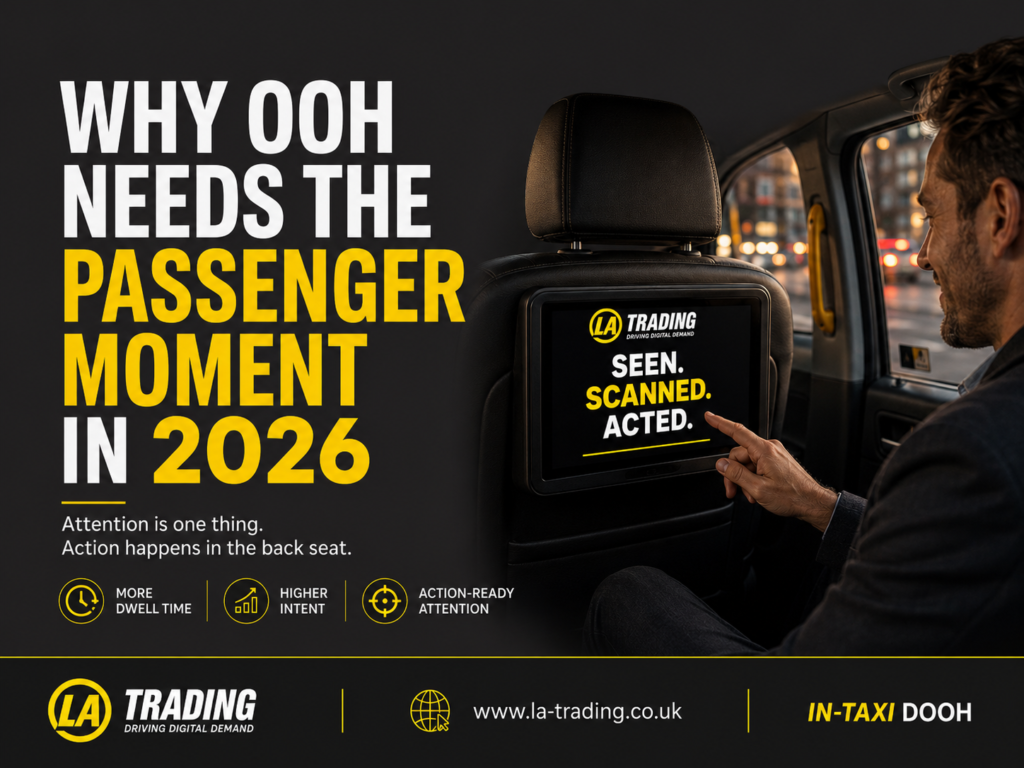
That is where the passenger moment comes in.
The Passenger Moment Feels Different
Inside a taxi, the audience is no longer rushing past.
They are not walking through a station trying to find Platform 6.
They are not glancing at a screen while crossing a road.
They are seated.
They are travelling.
They are between one part of their day and the next.
That shift is important.
A passenger has something many media environments struggle to offer:
time.
Not endless time. Not “read a 42-page whitepaper” time. But enough time to notice a brand, understand a message, scan a QR code, remember an offer, or simply let the creative land properly.
That is powerful because modern advertising is not just fighting for reach anymore.
It is fighting for quality attention.
And quality attention is much harder to buy than impressions.
Why This Matters for OOH Brands and Agencies
For OOH media owners, agencies, and large brand teams, taxi DOOH should not be seen as a rival to traditional outdoor.
It should be seen as an extension of the campaign journey.
A billboard can create the big public impact.
In-taxi DOOH can create the closer passenger interaction.
One builds fame.
The other builds depth.
Together, they help a campaign feel bigger, smarter, and more connected.
That is especially useful for campaigns where the brand needs more than just awareness.
Think:
- Hospitality launches.
- Retail promotions.
- University campaigns.
- Property developments.
- Travel offers.
- Events.
- Entertainment.
- Financial services.
- Healthcare and wellness.
- Local tourism.
- Citywide brand activity.
These are campaigns where being seen matters, but timing matters too.
A passenger heading to dinner, a hotel, the airport, a meeting, a shopping district, or an event is already in a decision-making mindset.
That makes the taxi environment feel less like an ad placement and more like a relevant moment.
The Last Mile Is Where Recall Gets Stronger
There is a reason brands spend heavily on repetition.
People rarely act after one exposure.
They need the brand to feel familiar.
They need the message to appear again.
They need enough time to think, “Oh yes, I’ve seen that.”
The difference in 2026 is that repeated exposure does not have to mean shouting the same message everywhere.
It can mean building a smarter media path.
A strong campaign might work like this:
A person sees a roadside billboard on the way into town.
They spot the same campaign near a shopping district.
Later, they enter a taxi.
The in-taxi screen delivers the next version of the message — more personal, more useful, more actionable.
Suddenly, the campaign feels connected.
Not annoying.
Not repetitive for the sake of it.
Connected.
That is where brand recall starts to strengthen.
In-Taxi DOOH Gives Big Campaigns a More Human Layer
The best advertising in 2026 will not just be bigger.
It will be better timed.
That is why in-taxi DOOH is so interesting for agencies planning high-impact campaigns. It offers a human layer inside a real-world journey.
Passengers are not just data points moving across a planning document.
They are people heading somewhere.
They may be excited, tired, curious, hungry, late, early, nervous, celebrating, travelling for work, or exploring a city for the first time.
That emotional context matters.
A message seen during a real journey can feel more memorable than another digital impression lost in a feed.
And when a brand shows up in that moment, it does not need to scream.
It just needs to be relevant.
The FOMO Bit: Your Competitor May Already Be Planning This
Here’s the uncomfortable bit.
If your OOH campaign ends when someone walks past your billboard, you may be leaving attention on the table.
Because the audience does not stop moving after they see your campaign.
- They keep travelling.
- They get into taxis.
- They head to meetings.
- They go to restaurants.
- They visit shops.
- They attend events.
- They make decisions.
The question is whether your campaign is still with them when those decisions happen.
That is the opportunity.
And for brands that care about fame, recall, and action, it is becoming harder to ignore.
Final Thought
OOH is brilliant at creating the big moment.
But in 2026, the smartest campaigns will think about what happens after that moment.
They will build media plans that move from public visibility into passenger attention.
From citywide awareness into focused engagement.
From “I saw that brand” into “I remember that brand.”
That is the last mile of brand fame.
And if your campaign is already doing the hard work of being seen across the city, maybe the next question is simple:
What happens when your audience gets in the back seat?