Everyone Wants Attention. Few Channels Earn It Properly.
The word “attention” gets thrown around a lot in marketing.
But not all attention is equal.
A half-second glance is not the same as a focused viewing moment.
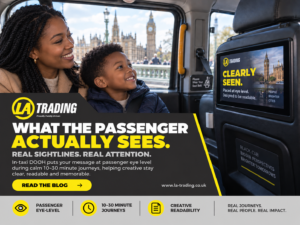
A skipped ad impression is not the same as a passenger sitting in front of a screen during a journey.
A forced interruption is not the same as a message that fits naturally into the environment.
That distinction matters.
Brands in 2026 are becoming more selective. They do not just want to know whether their campaign was delivered. They want to know whether it had a realistic chance of being noticed, understood, and remembered.
This is why OOH continues to hold such an important place in media planning.
It exists in the real world.
It does not rely on someone opening the right app at the right second.
It reaches people during actual movement, not just digital consumption.
But taxi DOOH takes that one step further by adding something rare:
a contained attention environment.
The Taxi Journey Creates a Natural Pause
A taxi journey has its own rhythm.
- You get in.
- You settle.
- You check your phone.
- You look around.
- You think about where you are going.
- You might talk.
- You might not.
You might mentally replay the meeting you just had and decide, with total confidence, that you should have said something much better 47 minutes ago.
It is a human moment.
And that is exactly why advertising can work differently there.
The passenger is not being aggressively interrupted.
The screen is part of the environment.
The brand appears during a natural pause in the day.
That makes the message feel less like another demand for attention and more like part of the journey.
For brands, that is incredibly valuable.
Calm Attention Builds Better Brand Memory
People remember advertising better when they have enough mental space to process it.
That sounds obvious, but much of modern advertising behaves as if the opposite is true.
- More impressions.
- More frequency.
- More retargeting.
- More noise.
More “just checking in” emails that make everyone feel slightly haunted.
But brand memory is not built by chasing people around the internet until they give in.
It is built through relevance, repetition, timing, emotion, and environment.
Taxi DOOH gives brands a chance to use all five.
A passenger sees the screen in a focused setting.
- The creative has time to land.
- The journey gives the message context.
- The brand feels present in real life.
And if the campaign includes QR, NFC, offers, location prompts, or landing pages, the passenger has enough time to respond without feeling rushed.
That is the premium pause in action.
Why OOH Campaigns Benefit From a Calm Layer
For large brands and OOH agencies, this is where in-taxi DOOH becomes strategically useful.
- Traditional OOH can create reach and fame.
- Taxi DOOH can create a calmer, closer brand moment.
- The two do not compete.
- They complement each other.
A citywide OOH campaign can make the brand visible across public spaces.
In-taxi DOOH can then bring that campaign into a passenger environment where the audience has more time to absorb it.
- That is not replacing the billboard.
- That is giving the billboard a better afterlife.
- It is campaign architecture.
And in 2026, campaign architecture matters more than ever.
Because the brands that win attention will not always be the ones shouting the loudest.
They will be the ones appearing in the right emotional context.
The Premium Pause Works Across High-Value Categories
Some industries especially benefit from calmer attention environments.
- Luxury brands.
- Hospitality.
- Travel.
- Property.
- Higher education.
- Automotive.
- Finance.
- Entertainment.
- Events.
- Health and wellness.
- Premium retail.
Why?
Because these are not always instant-click decisions.
They often require trust.
Interest.
Consideration.
A little bit of mental breathing room.
In-taxi DOOH gives advertisers the chance to create that breathing room without losing the visibility benefits of outdoor media.
The passenger is still in the real world.
The campaign still feels physical.
But the message has a more personal setting.
That combination is what makes the format feel so relevant for 2026.
The FOMO Bit: Calm Attention Is Getting Scarcer
Here is the part media planners should probably talk about more.
- Calm attention is not increasing.
- It is shrinking.
- More content is being created.
- More platforms are competing for time.
- More brands are fighting for the same digital spaces.
- More people are learning how to ignore all of it.
So when a media environment offers a passenger who is seated, present, and moving through a real-world journey, that becomes valuable.
Not because it is flashy.
Because it is rare.
And rare media moments are where smart brands often find an edge.
Final Thought
The future of advertising will not simply belong to the brands that reach the most people.
It will belong to the brands that reach people when they are most able to care.
That is the value of the premium pause.
- A quieter moment.
- A more focused setting.
- A better chance to be remembered.
- OOH gives brands the power of public presence.
- Taxi DOOH adds the calm attention layer that helps the message settle.
And in a world where everyone is fighting to be noticed, sometimes the smartest move is not to shout louder.
Sometimes it is to show up when the audience finally has a second to breathe.
Want your campaign to reach people during calmer, more focused journey moments? LA Trading’s in-taxi DOOH network helps brands turn travel time into meaningful attention.