Real Life Does Not Happen in Straight Lines
The traditional marketing funnel is useful, but it can make things feel too tidy.
Real-world behaviour is messier.
Someone might notice a brand while walking through a city centre.
Then see it again near a station.
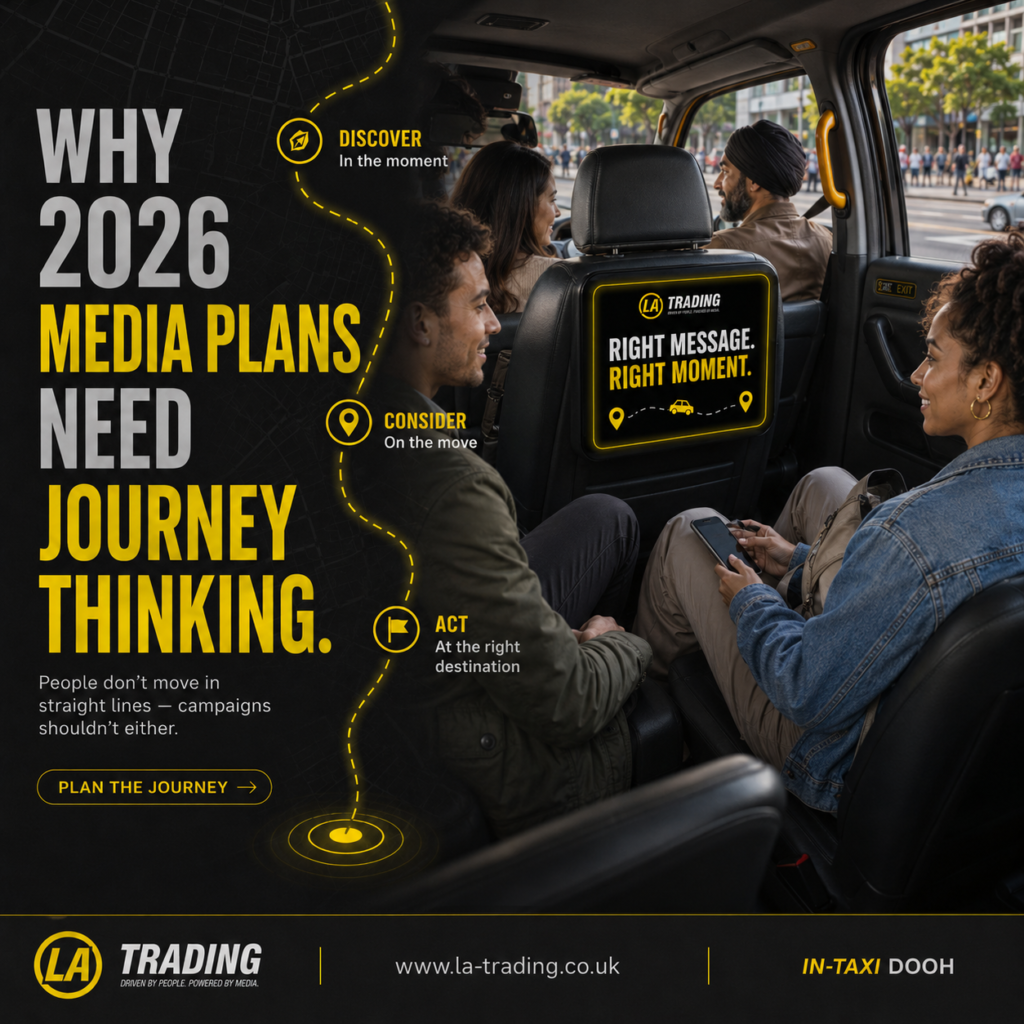
Then encounter it in a taxi while heading to a meeting.
Then scan a QR code because they finally have time.
Then come back later when the need becomes real.
That is not a straight path.
That is a city journey.
And brands that understand this can build better campaigns.
Instead of asking only, “Where can we place this ad?”
They ask:
“Where is the audience emotionally when they see it?”
“Are they rushing?”
“Are they waiting?”
“Are they travelling with intent?”
“Do they have time to respond?”
“Does this moment make the message more relevant?”
These are better questions for 2026.
OOH Is the Public Layer of the Journey
OOH works beautifully because it meets people in the world they already move through.
- Roads.
- Stations.
- Shopping areas.
- Business districts.
- Entertainment zones.
- Transport routes.
It does not need to drag people into a platform.
It exists naturally in public life.
That gives brands credibility.
It also gives campaigns a sense of scale.
But once the audience keeps moving, the campaign needs to think about what comes next.
That is where DOOH becomes powerful.
And in-taxi DOOH adds a particularly valuable layer because it sits inside the journey itself.
Not beside it.
Inside it.
Taxi DOOH Turns Movement Into Media
A taxi is not just a vehicle.
For advertisers, it is a moving media environment.
It travels through city routes, nightlife zones, business areas, hospitality districts, airports, events, shopping streets, and hotel corridors of movement.
The passenger is not just being reached geographically.
They are being reached in a moment of transition.
That matters.
A person travelling to an event is in a different mindset to someone scrolling at home.
A person heading to dinner is in a different mindset to someone walking past a roadside panel.
A person on an airport run may be thinking about travel, hotels, finance, business, family, shopping, or planning ahead.
Journey context changes how advertising feels.
And when advertising feels more relevant, it has a better chance of being remembered.
Why Agencies Should Care About Journey-Based DOOH
For agencies working with large brands, journey thinking creates a stronger planning story.
It helps connect media channels without pretending they all do the same job.
- Large-format OOH can build fame.
- Transport media can build repeated visibility.
- Retail media can support purchase intent.
- Experiential can create emotional interaction.
- Taxi DOOH can bring the campaign into a seated, focused journey moment.
Each channel has a role.
The clever bit is making them work together.
That is what clients increasingly want in 2026: not just a list of placements, but a connected campaign ecosystem.
OOH and DOOH are well placed for that because they already live in the real world.
Taxi DOOH simply gives the journey a more personal media layer.
The Human Advantage: People Remember Moments, Not Media Plans
Nobody outside the marketing department remembers a media plan.
They remember moments.
- The ad they saw before a big night out.
- The campaign that made them laugh on the way to the airport.
- The brand that appeared just when they were thinking about booking something.
- The message that felt oddly well-timed.
The QR code they scanned because they actually had a minute.
That is the human side of media planning.
People do not experience campaigns as channels.
They experience them as moments in their day.
The better the moment, the stronger the memory.
The FOMO Bit: Journey Gaps Are Costing Brands Attention
Many brands are already investing heavily in visibility.
That is good.
But visibility without journey thinking can leave gaps.
- A campaign may be seen in public but missed during decision moments.
- A message may create awareness but fail to give people a next step.
- A brand may dominate one location but disappear once the audience moves.
- Taxi DOOH helps close those gaps.
It lets campaigns travel with people during the moments between destinations.
That is where attention often becomes more available.
Not because people are doing nothing.
Because they are between things.
And “between things” is where a lot of modern decision-making happens.
Final Thought
The city is not a funnel.
It is a living, moving, unpredictable collection of journeys.
People are not simply moving from awareness to conversion.
They are moving from meeting to dinner, airport to hotel, train station to office, shop to restaurant, event to home.
That is where modern media planning gets interesting.
- OOH gives brands the public stage.
- DOOH gives campaigns flexibility.
- In-taxi DOOH gives the journey a focused brand moment.
Together, they help brands stop planning for imaginary funnels and start showing up in the real world, where people actually are.
And in 2026, that might be the smartest shift a campaign can make.
Planning a campaign that needs more than static visibility? Speak to LA Trading about how in-taxi DOOH can help your brand reach audiences across real-world journeys with focused attention and measurable engagement.