Connected commerce is moving into the real world
Commerce media has traditionally been associated with moments close to purchase: retailer websites, marketplaces, apps, loyalty ecosystems and increasingly physical stores.
But the boundaries are becoming less tidy.
Industry research published by the OAAA and Winterberry Group in 2026 found OOH increasingly being incorporated into purchase-driven strategies, reflecting a wider movement towards connecting physical exposure with digital and commercial outcomes.
Meanwhile, retailers themselves are becoming significant DOOH media owners. In the UK, Co-op launched a national standalone Digital Out of Home proposition in 2026, another indication that physical audience environments and commerce media are getting closer together.
This matters.
Because a purchase does not begin at the till.
It begins with awareness.
Curiosity.
Recognition.
Preference.
Timing.
Sometimes hunger.
Often convenience.
Occasionally seeing something at precisely the moment your brain says, actually, yes, I do need that.
OOH has always been exceptionally good at entering that process early.
DOOH gives marketers more ways to remain part of it.
The opportunity between the billboard and the basket
Imagine a national restaurant campaign.
Large-format OOH builds fame across the city.
Digital panels reinforce the campaign around key districts.
Retail or proximity media captures customers closer to purchase.
But there is another useful moment in between:
the journey towards the destination.
Someone travelling into a city centre may already be thinking about:
- where to eat;
- where to shop;
- what to book;
- what to do afterwards;
- where their hotel is;
- whether they’ve forgotten someone’s birthday.
Again.
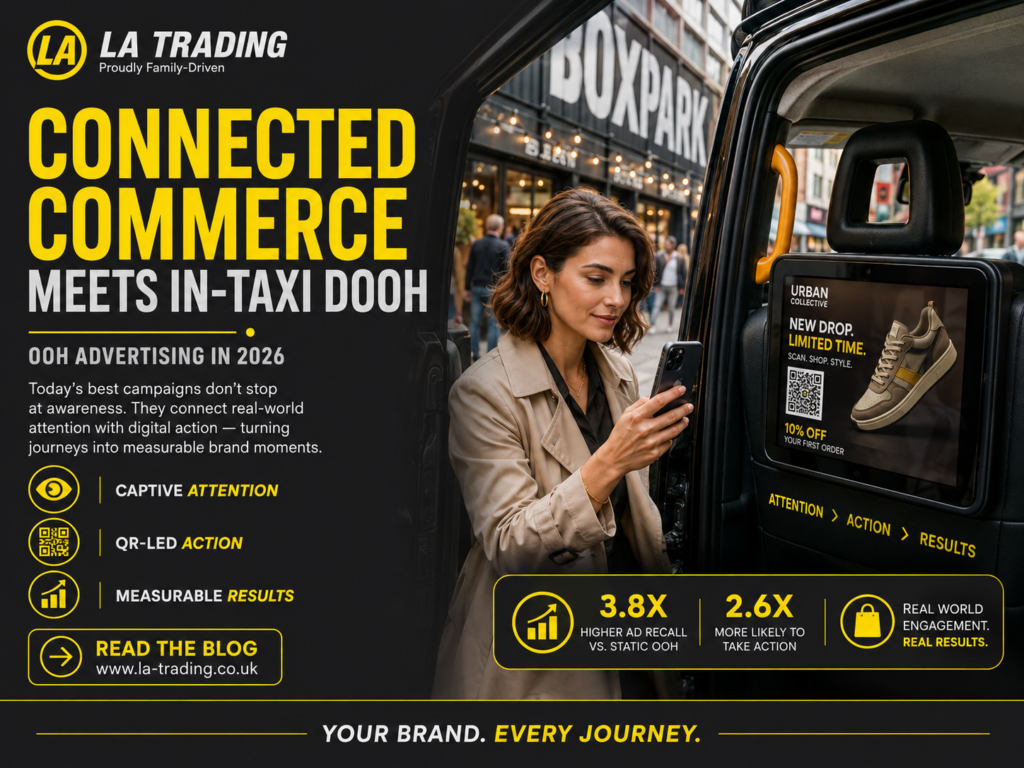
An in-taxi digital screen can occupy that middle ground.
Not instead of the billboard.
Not instead of retail media.
Not instead of mobile.
It becomes another connected physical touchpoint.
LA Trading describes its network as bridging traditional OOH and DOOH through internal taxi screens, with location-based targeting, measurable reporting and interactive pathways available to advertisers.
For planners, that creates an interesting question:
What if the journey itself became part of the commerce strategy?
OOH does something commerce media desperately needs
Commerce media can be incredibly powerful near purchase.
But brands still need fame.
Nobody wakes up excited about buying from a company they have never heard of merely because its sponsored listing appeared first.
Brand-building still matters.
Familiarity still matters.
Trust still matters.
And this is where OOH continues to earn its place.
It makes brands public.
A good OOH campaign says:
“We exist in the real world.”
There is cultural weight in that.
Physical presence can make a brand feel established before anyone clicks, scans, searches or buys.
That is not something DOOH should attempt to replace.
The opportunity is to connect it.
Large-format OOH might make someone recognise the brand.
In-taxi DOOH might develop the message.
Retail media might capture intent.
Search might answer the final question.
The store, site or app closes the loop.
Different jobs.
One customer.
Much better than asking every channel to pretend it caused everything.
Stop thinking about channels as separate islands
One of the stranger habits in marketing is giving consumers a completely different personality depending on which media team is discussing them.
The social team has a “user”.
Retail has a “shopper”.
OOH has an “audience”.
CRM has a “customer”.
Meanwhile, Dave from Manchester is simply trying to get into town and buy some trainers.
The consumer does not experience your media departments.
They experience your brand.
That is why connected commerce matters.
The campaign should make sense from their perspective.
If someone has seen a strong OOH execution, the DOOH follow-up should feel familiar.
If they are approaching a commercial district, the message can become more useful.
If there is a sensible action to take, make it easy.
If there isn’t, don’t glue a QR code onto the artwork because somebody discovered QR codes during the meeting.
Sometimes the best job advertising can do is simply make you remember the name.
The FOMO for advertisers is the space between moments
Here’s where brands should pay attention.
Your competitors may already be visible on the street.
They may already own search terms.
They may already be investing in retail media.
They may already appear close to purchase.
The gap is often between those moments.
Journeys.
Transfers.
Waiting periods.
Movement between districts.
The physical moments when a customer has already left one environment but has not yet entered the next.
That is valuable territory.
And as connected commerce becomes more sophisticated, ignoring those physical transition points could mean leaving useful attention unplanned.
Not because every taxi passenger is about to buy something.
They aren’t.
But because brands are built through connected memories long before the final transaction.
What this means for OOH agencies and media owners
This is not an argument for taking money away from OOH.
Quite the opposite.
Connected commerce gives OOH more strategic relevance, not less.
It allows an OOH plan to stretch beyond awareness without pretending that awareness is somehow outdated.
A strong media approach could combine:
Large-format OOH for public scale and fame.
Digital OOH for adaptability and location.
Transit and in-taxi environments for movement and passenger context.
Retail media for proximity to purchase.
Search and mobile for active investigation.
That is not channel competition.
That is choreography.
And good choreography is rather more impressive than everyone dancing independently and hoping the client thinks it was intentional.
A useful question for your next campaign
Before finalising your next OOH plan, ask:
Where is our customer likely to go after seeing us?
Not metaphorically.
Literally.
Are they travelling into town?
Heading towards hospitality?
Leaving an airport?
Going from a station to a hotel?
Moving between meetings?
Shopping?
Attending an event?
Those journeys can reveal media opportunities that a conventional location plan may not immediately show.
The city stops being a collection of sites.
It becomes a collection of commercial moments.
Final thought: the purchase journey has left the spreadsheet
Connected commerce is not about turning every physical surface into a checkout button.
Thank goodness.
Nobody needs a lamp post aggressively asking for their card details.
It is about recognising that real-world visibility and commercial behaviour are increasingly connected.
OOH builds fame beautifully.
DOOH introduces flexibility.
Retail media gets closer to the purchase.
And passenger environments can help join parts of that story while people move between them.
The opportunity in 2026 is not simply to buy another screen.
It is to understand what role that screen plays in the customer’s day.
So the next time someone draws a perfectly straight customer journey on a PowerPoint slide, admire it.
Then remember that the customer has probably gone completely off-route.
Planning an OOH campaign that needs to connect more of the real-world customer journey? Talk to LA Trading about adding in-taxi DOOH to your wider media strategy — or ask us to mock up how your existing OOH creative could continue inside the passenger journey.