Why context matters more than ever
People are not walking around waiting to be advertised to. Shocking, we know. Most people do not wake up thinking, “I hope a brand finds me today.”
They are busy. They are commuting, booking, buying, meeting, waiting, travelling, rushing, relaxing, deciding and occasionally pretending they know which train platform they need.
That means modern media needs to work with behaviour, not against it.
This is where contextual DOOH advertising becomes valuable. It allows campaigns to feel more naturally connected to the real world around the audience.
A lunch offer makes more sense near midday.
A hotel advert works harder around stations and airports.
An event message feels stronger near nightlife routes.
A property campaign becomes more relevant in high-value postcode journeys.
A recruitment message can land better during commuter travel.
The creative does not need to guess. It can respond to the journey.
OOH builds the stage. DOOH changes the scene.
Traditional OOH gives brands scale, fame and repeated exposure. That matters. It makes campaigns visible in the physical world and helps people recognise brands outside the digital bubble.
DOOH does not need to compete with that. It can build on it.
Think of OOH as the stage.
Think of contextual DOOH as the lighting, timing and scene change.
The same brand message can become more effective when it adapts to where people are and what they are likely to be thinking about.
Inside a taxi, this becomes especially interesting.
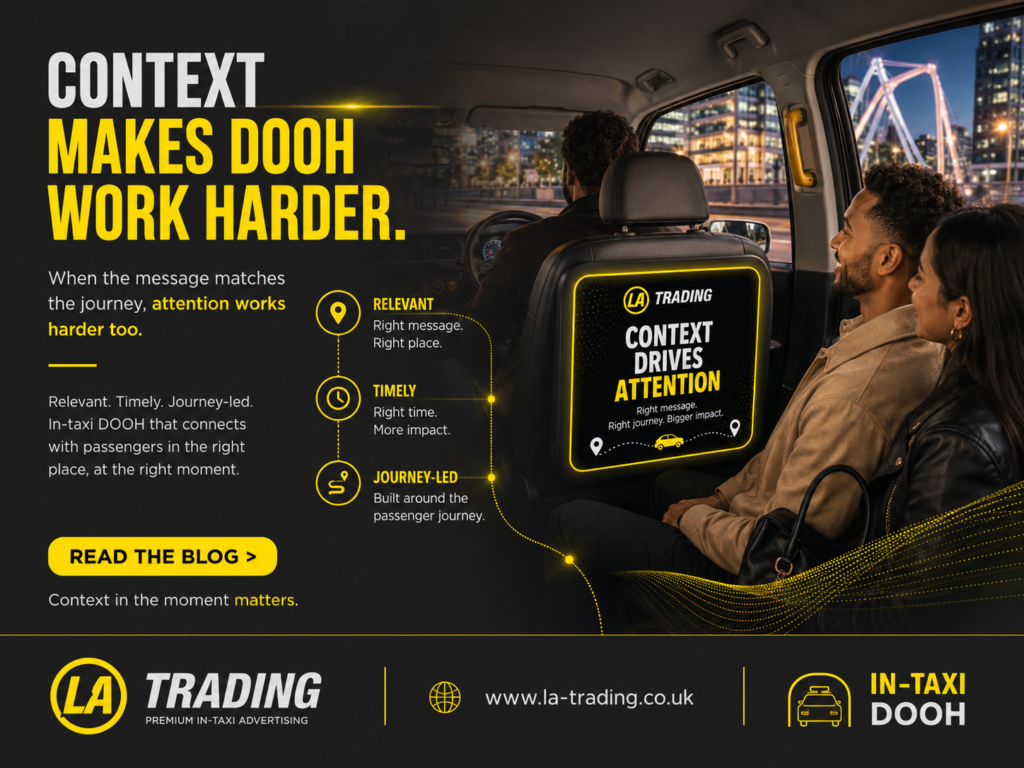
Passengers are not just passing an advert. They are travelling through a live context. The journey has a start point, an end point, a time of day and a reason behind it. That gives brands a more meaningful way to show up.
The taxi is a moving context machine
A taxi journey is rarely random.
Someone is going somewhere. That sounds obvious, but it is exactly why the environment is so valuable.
They might be heading to a restaurant, hotel, airport, event, meeting, shopping area, university, viewing, clinic, venue or station. They are in motion with purpose.
That means in-taxi DOOH can support campaigns with creative that feels closer to the passenger’s situation.
For example:
A restaurant brand can advertise when people are travelling into town.
A theatre or event campaign can appear during evening journeys.
A property developer can focus messaging around target postcodes.
A retail campaign can promote store visits near shopping districts.
An app campaign can use QR or NFC to drive immediate downloads.
A local service can become visible while passengers are nearby and receptive.
This is not about replacing broad OOH reach. It is about giving that reach more relevant follow-through.
The creative advantage: fewer generic messages
The old way of planning creative often involved making one message and hoping it worked everywhere.
The 2026 way is smarter.
Contextual DOOH advertising allows brands to create variations that feel more alive. Not complicated. Not over-engineered. Just more relevant.
Morning creative can speak to commuters.
Afternoon creative can focus on errands, shopping or appointments.
Evening creative can lean into food, entertainment or nightlife.
Weekend creative can shift towards leisure, family or tourism.
A campaign can still have one big idea. It simply gets different expressions depending on the journey.
That is not fragmentation. That is fluency.
Why this matters for OOH brands and media planners
OOH media owners and agencies already understand place. They know that location shapes message impact. A campaign in a transport hub has a different energy from one near a retail park. A city-centre placement creates a different mindset from a roadside route.
In-taxi DOOH adds another layer to that planning logic.
It gives brands a media environment where context can continue after the first public exposure. The audience moves from the street into the vehicle, and the campaign has another opportunity to be relevant.
That makes DOOH a strong partner for OOH campaigns that want to build:
- Better recall
- Local relevance
- Interactive engagement
- Real-world action
- Flexible creative testing
- Stronger journey-based storytelling
It is not about saying one channel is better than another. It is about building a smarter sequence.
Context makes conversion feel less forced
Nobody likes a desperate CTA.
We have all seen adverts that behave like a salesperson sprinting across a car park.
“BUY NOW.”
“DON’T MISS OUT.”
“LAST CHANCE.”
“WHY ARE YOU WALKING AWAY?”
Contextual DOOH gives brands a calmer way to invite action.
If someone is already near your venue, a “scan for directions” message makes sense.
If someone is heading into town, a food or drink offer feels useful.
If someone is on the way to an airport, a travel product has natural relevance.
If someone is in a taxi during a city event, a location-based campaign feels timely.
The CTA works because the context has done half the persuasion already.
The human bit: relevance feels respectful
Good advertising does not just chase attention. It respects the person behind the impression.
That is why context matters emotionally.
A relevant message feels considered. It says, “We understand where you are right now.” A generic message says, “We bought space and hoped for the best.”
In 2026, people are quicker to ignore anything that feels lazy. They are also more likely to engage with brands that understand timing, place and mood.
Contextual DOOH helps brands feel more human because it gives the message a reason to be there.
Final thought
Context is not a gimmick. It is the difference between an advert that appears and an advert that belongs.
OOH gives brands the scale to be seen. DOOH gives brands the flexibility to be relevant. In-taxi DOOH brings both into the journey, helping campaigns move with people in a way that feels natural, timely and measurable.
So, yes, context might be the new creative director.
And unlike some creative directors, it will not ask for a three-hour meeting to explain the mood board.
Want your OOH campaign to work harder across real journeys? Talk to LA Trading about contextual in-taxi DOOH campaigns built around location, timing and passenger attention.