What happens after the first big impression?
Because awareness is powerful.
But awareness with a second moment of attention?
That is where campaigns start to feel properly joined up.
This is where in-taxi DOOH becomes a seriously interesting extension of the wider OOH mix.
Not a replacement.
Not a “move over billboards” moment.
More like the quiet genius friend who turns up after the headline act and makes sure everyone actually remembers the night.
OOH Builds the Stage. DOOH Keeps the Conversation Going.
Traditional OOH gives brands a public footprint. It tells the market: “We’re here.”
Roadside formats, transport media, retail environments, city-centre placements — they all play a major role in building recognition and trust. That visibility still matters enormously.
But today’s customers rarely move in a straight line.
They see a roadside campaign.
They walk past a bus shelter.
They jump into a taxi.
They check their phone.
They arrive at a restaurant, office, hotel, event, or shop.
The customer journey is no longer one moment. It is a trail of little moments.
And the brands that win are the ones that connect those moments without exhausting the audience.
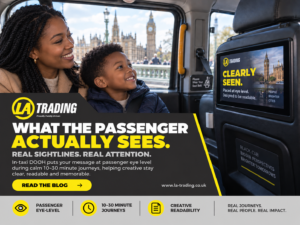
LA Trading’s in-taxi digital screens are built for that second layer of engagement, placing brands directly inside passenger journeys where people can sit, notice, process, and act. The company positions its platform around in-taxi screens that turn taxi journeys into immersive brand experiences, with passengers typically in a chosen travel moment where they can engage with what is in front of them.
The Missed Opportunity: Campaigns That Stop Too Early
A lot of campaigns do the hard part well.
They get seen.
The creative looks good.
The media plan has scale.
The brand feels present.
The launch gets attention.
Then the campaign stops at visibility.
That is a missed opportunity, especially for brands that want more than awareness. In 2026, marketers are under pressure to show how brand activity supports action. Not just “people saw it,” but “people remembered it, scanned it, searched it, visited it, spoke about it, or bought from it.”
That does not mean every OOH campaign needs to become performance marketing. It does mean the best campaigns now need a stronger bridge between public visibility and measurable engagement.
In-taxi DOOH is one of those bridges.
It gives brands a chance to appear after the public-facing OOH moment, but in a more personal space. The passenger is no longer rushing past. They are seated. They are travelling. They have time.
And time is underrated.
Why the Taxi Environment Works as a Second Touchpoint
A roadside billboard might create the first spark.
An in-taxi screen can create the second thought.
That second thought might be:
“Actually, I’ve seen this brand twice today.”
“That offer is near where I’m going.”
“I’ll scan that QR code.”
“That’s the one from the campaign I noticed earlier.”
This matters because memory is built through reinforcement. Not annoying repetition. Not hammering people with the same message until they start seeing your logo in their sleep.
Good reinforcement feels natural.
Taxi DOOH works because it sits inside a real journey. The advert is not interrupting a video, invading a feed, or hiding between memes. It is part of the passenger environment.
LA Trading highlights in-taxi advertising as complementary to wider OOH strategies, extending reach into a captive environment and transforming dwell time into engagement and measurable impact.
That is the sweet spot:
OOH creates fame. Taxi DOOH deepens familiarity.
A 2026 Campaign Should Not Just Be Seen. It Should Travel.
Here is where things get interesting for OOH planners.
Imagine a campaign for a hotel group.
The large-format OOH does the big awareness job near airports, stations, and city centres.
The taxi DOOH layer then speaks to passengers during airport transfers, business journeys, or evening travel.
The message can invite people to scan, check availability, book a stay, claim a dining offer, or simply remember the brand when planning their next trip.
Now imagine a retail brand.
OOH builds citywide presence.
Taxi DOOH supports location-specific messaging near shopping districts or events.
The creative nudges passengers toward a store, website, offer, or launch.
Or a property brand.
OOH builds credibility.
Taxi screens turn passive awareness into guided interest through QR codes, location prompts, and longer-format messaging.
That is not random repetition.
That is campaign choreography.
The New Media Planning Question: “Where Does the Brand Go Next?”
The best 2026 media plans will not only ask:
“How many people can we reach?”
They will also ask:
“Where does the customer go after they see us?”
That question opens the door for smarter OOH and DOOH partnerships.
A customer may see the headline campaign in public, then experience a more detailed or interactive version inside a taxi. That is where brands can move from recognition to relevance.
In-taxi DOOH can help answer questions that big awareness formats are not always designed to answer:
What does the offer actually involve?
Where can I go next?
Can I scan this now?
Is this available near me?
Can I remember this later?
The large format starts the story.
The taxi screen gives the story a second chapter.
Why This Complements OOH Brands Instead of Competing With Them
This is important.
The future is not “OOH versus DOOH” or “billboards versus taxis.” That is far too basic.
The future is layered.
Big OOH formats still create authority, scale, and cultural presence. They make brands feel established. They help campaigns feel unavoidable in the best possible way.
Taxi DOOH adds intimacy, dwell time, and interaction.
Together, they do different jobs inside the same customer journey.
This is why LA Trading’s platform is especially relevant for OOH media owners, agencies, and brands that already believe in the power of physical-world advertising. The opportunity is not to pull budget away from great OOH. It is to make OOH campaigns work harder after the first impression.
A Human Way to Think About It
Think of a campaign like meeting someone at an event.
The billboard is the confident introduction.
The taxi screen is the proper conversation after.
The introduction matters. Without it, nobody knows who you are. But the conversation is where people start to remember your name, understand what you do, and decide whether they want to hear more.
That is the “after the billboard” effect.
And in 2026, it may be one of the most useful ways to build stronger OOH campaign outcomes.
Final Thought
The brands that win in 2026 will not simply appear in more places.
They will appear in smarter sequences.
Big public visibility first.
Focused passenger engagement next.
Measurable action after that.
OOH gives brands the stage.
Taxi DOOH helps the message travel with the audience.
And honestly, if your campaign already has people looking up at it, why not give them something to look at again when they sit down?
If your next OOH campaign needs a stronger second touchpoint, LA Trading can help extend your message into high-attention in-taxi digital environments across the UK. Start with the street. Continue in the seat by…